
Last updated on August 25th, 2026 at 11:50 am
The engine control module in the 2006 Volkswagen Jetta acts as the central computer managing fuel and ignition parameters. When this unit malfunctions, it often causes erratic drivability, failed emissions, or prevents the engine from starting altogether.
When a 2006 Volkswagen Jetta develops intermittent running issues or refuses to start, the engine control module often becomes a suspect. This critical computer dictates how the fuel and ignition systems behave, meaning a malfunction directly impacts vehicle reliability. Understanding what this component does, where it resides, and how it is serviced helps you make informed repair decisions. Replacing a faulty unit involves specific labor times and precise programming steps that can catch drivers off guard. By exploring the symptoms, factory service bulletins, and installation requirements for your vehicle, you gain clarity on whether the module is truly at fault. You also avoid unnecessary parts swapping, as some diagnostic trouble codes do not warrant module replacement. Knowing the exact location and labor times allows you to approach the repair with confidence, whether you handle the wrenching yourself or rely on a professional technician.
In the 2006 Volkswagen Jetta, the engine control module serves as the primary brain for the 1.9L diesel powertrain. It continuously adjusts fuel delivery, turbo boost, and emissions controls based on real-time sensor data. When this processor operates correctly, your vehicle runs efficiently and meets emissions standards. However, internal circuit failures or software glitches often disrupt these calculations, leading to poor performance or a no-start condition. Diagnosing these failures requires separating software bugs from actual hardware faults, which can be challenging. If the unit is physically damaged, searching for Volkswagen Jetta engine computers provides the necessary replacement hardware. A malfunctioning module typically triggers the malfunction indicator lamp and stores specific fault codes. Because the 1.9L engine relies heavily on precise fuel metering, even minor processor errors may cause noticeable drivability problems. Recognizing the role of this computer helps you understand why proper programming and installation are vital to restoring normal function.
2006 Volkswagen Jetta
OEM programmed ECM for your 2006 Volkswagen Jetta — plug & play, no dealer visit.
Free shipping · Lifetime warranty
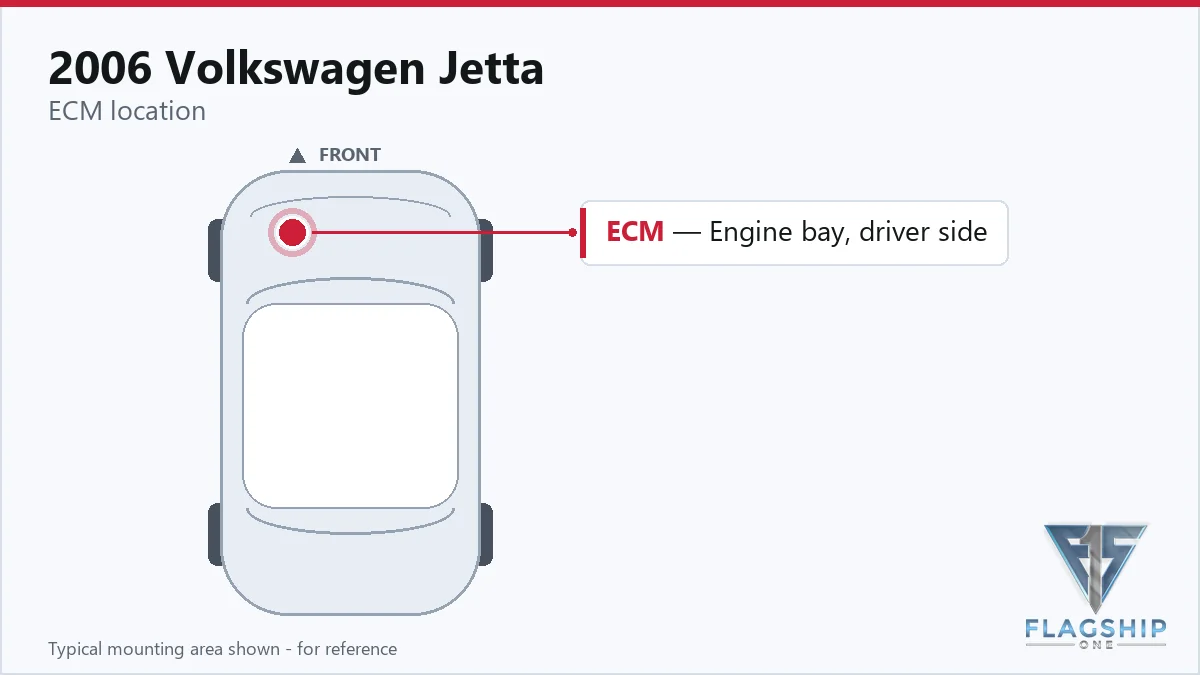
Locating the engine control module on the 2006 Volkswagen Jetta requires looking inside the plenum chamber on the right side of the engine bay. This position protects the unit from excessive heat while keeping it accessible. The transmission control module, by contrast, resides in the left front wheel housing for specific Jetta models from 2005 through 2010. When replacing the engine computer, the industry standard involves removing the old unit and installing the replacement, which typically takes 1.4 hours of labor. After the physical swap, technicians often need 0.3 hours to perform a module reset. Additionally, completing the job requires 0.5 hours for an engine control module relearn or a powertrain control module relearn. The removal and installation for the 1.9L powertrain control module also requires 1.4 hours. These specific times ensure the vehicle systems are correctly synchronized following the repair.
Work with the ignition off, and treat the module as static-sensitive: avoid touching the connector pins at any point.
| Operation | Configuration | Book Time |
|---|---|---|
| Engine Control Module R&R | All configurations | 1.4 hr |
| Engine Control Module Reset | All configurations | 0.3 hr |
| Engine Control Module Relearn | All configurations | 0.5 hr |
| Powertrain Control Module Relearn | All configurations | 0.5 hr |
| Powertrain Control Module R&R | 1.9L | 1.4 hr |
| Powertrain Control Module R&R | 2.0L | 1.4 hr |
Following the installation of a new engine computer, factory procedures demand specific programming steps to ensure the 2006 Volkswagen Jetta runs correctly. The process normally involves a module reset taking 0.3 hours, followed by a relearn procedure requiring 0.5 hours. These steps synchronize the replacement hardware with your vehicle immobilizer and factory specifications. Skipping these protocols often results in starting issues or lingering fault codes. Fortunately, choosing a pre-programmed replacement unit from Flagship One eliminates the need for these dealership programming steps. Because the necessary vehicle identification number data and software are already loaded, you avoid the reset and relearn entirely. This means your vehicle can typically start and run immediately after the physical installation is complete, saving both time and labor costs.
When the engine computer begins to fail in the 2006 Volkswagen Jetta, several noticeable drivability issues often arise. Drivers frequently encounter stalling at idle, rough running conditions, or a complete no-start situation. Sometimes, the diagnostic scanner cannot establish communication with the module, pointing directly to an internal processor fault. Other times, the vehicle may exhibit shifting irregularities if the engine and transmission controllers fail to share data properly. Illuminated warning lamps and stored fault codes are common, and you might find catalyst efficiency fault code alongside misfire or sensor codes. Because internal circuit degradation progresses over time, these symptoms may start intermittently before becoming constant. Recognizing these signs early helps prevent being stranded and ensures accurate diagnosis before replacing other expensive sensors that are merely reacting to a failing computer.
Volkswagen has issued specific technical service bulletins regarding the 2006 Jetta engine computer. Bulletin 01-07-54 explicitly advises against replacing the module for certain diagnostic trouble codes, indicating that other repairs are necessary. Additionally, bulletin 01-09-09 addresses check engine light concerns accompanied by specific fault codes stored in the module memory. These codes include P0300 through P0304, P0102, P1297, P0420, and P0441. For these particular errors, the manufacturer recommends updating the programming rather than swapping the hardware. Consulting these bulletins before purchasing parts may save considerable time and expense, as a software update could resolve the issue without requiring physical module replacement.
| Bulletin | Subject | What It Addresses |
|---|---|---|
| 01-07-54 | 01-07-54 – Engine Control Module (ECM), DO NOT Replace for These Diagnostic Trouble Codes (DTCs | — |
| 01-09-09 | Attachment: 01-09-09 – Update Programming, MIL ON, DTCs P0300-P0304, P0102, P1297, P0420 and P0 | — |
The specified time for removing and reinstalling the engine control module is 1.4 hours. Performing a reset requires an additional 0.3 hours, while the relearn procedure takes 0.5 hours.
The engine control module is situated inside the plenum chamber on the right side of the engine bay. This location helps shield the unit from excessive heat while remaining accessible for servicing.
If you install a unit that is already programmed with your vehicle identification number, the dealership visit is typically unnecessary. Flagship One provides these units pre-programmed, eliminating the need for the reset and relearn procedures.
Deciding between repairing or replacing the engine computer in your 2006 Volkswagen Jetta depends on the specific failure mode. While software glitches addressed by factory bulletins may only require an update, internal hardware failures often necessitate a refurbished replacement. Choosing a pre-programmed unit simplifies the process, bypassing complex dealership programming procedures.
Flagship One stocks a refurbished, VIN-programmed PCM for the 2006 Volkswagen Jetta with a lifetime warranty, free shipping and no core charge. The full Volkswagen Jetta module lineup covers other engine configurations as well.
Diagnosing engine computer issues in the 2006 Volkswagen Jetta requires careful attention to labor times, locations, and factory bulletins. By understanding the specific symptoms and avoiding unnecessary parts swaps, you address the root cause effectively. When internal failure is confirmed, exploring quality replacement options restores your vehicle to reliable working order.