
Last updated on August 25th, 2026 at 12:02 pm
The powertrain control module in the 2006 Toyota Highlander manages critical engine and transmission functions to maintain optimal vehicle performance. When this module malfunctions, it often triggers internal fault codes, causes erratic shifting, or prevents the engine from starting.
Encountering drivability issues or warning lights on your 2006 Toyota Highlander can be frustrating, especially when the root cause points to the vehicle’s main computer. The powertrain control module acts as the brain for your engine and transmission, dictating crucial operational parameters. When this component begins to fail, you may experience anything from intermittent stalling to a complete no-start condition. Understanding how this system works, where it is located, and what it takes to replace it empowers you to make informed repair decisions. This guide outlines the specific details for the 3.3L Highlander, covering factory repair times, access procedures, and programming requirements. By learning the common symptoms and necessary relearn procedures, you can approach the repair with confidence and ensure your vehicle returns to proper operating condition without unnecessary delays.
In the 2006 Toyota Highlander, the powertrain control module coordinates the fuel injection, ignition timing, and transmission shifting strategies to keep the 3.3L engine running efficiently. This computer constantly processes data from various engine sensors to adjust operational parameters in real time. When the internal circuitry degrades, engine performance typically suffers, and the vehicle may enter a reduced-power state or stall unexpectedly. Accessing reliable 2006 Toyota Highlander replacement modules ensures that you restore proper communication between the engine and transmission components. A malfunctioning unit often sets specific internal fault codes that cannot be resolved through simple sensor replacements. Because the module controls vital emissions equipment, a failure can also lead to increased tailpipe emissions, potentially causing your vehicle to fail state or local inspection programs. Replacing a degraded computer restores the factory calibration and ensures the powertrain operates as originally intended.
Engine computer (ECM/PCM)
OEM programmed replacements — plug & play, no dealer visit.
Find yours by year, make & model →
Free shipping · Lifetime warranty
The factory removal procedure indicates that the control module sits behind the cowl side trim on the right side. To access the unit, the technician must detach the battery negative terminal, the front door scuff plate on the right side, the cowl side trim sub-assembly on the right side, the glove compartment door, and the instrument panel finish panel. According to book time standards, removing and reinstalling the powertrain control module on the 3.3L engine takes 0.4 hours. Additionally, the relearn procedure for the powertrain control module requires 0.5 hours. The engine control module relearn also requires 0.5 hours, while the engine control module removal and installation takes 0.4 hours. Following the specific access path ensures you do not damage the surrounding interior trim pieces during the removal process, allowing for a straightforward installation.
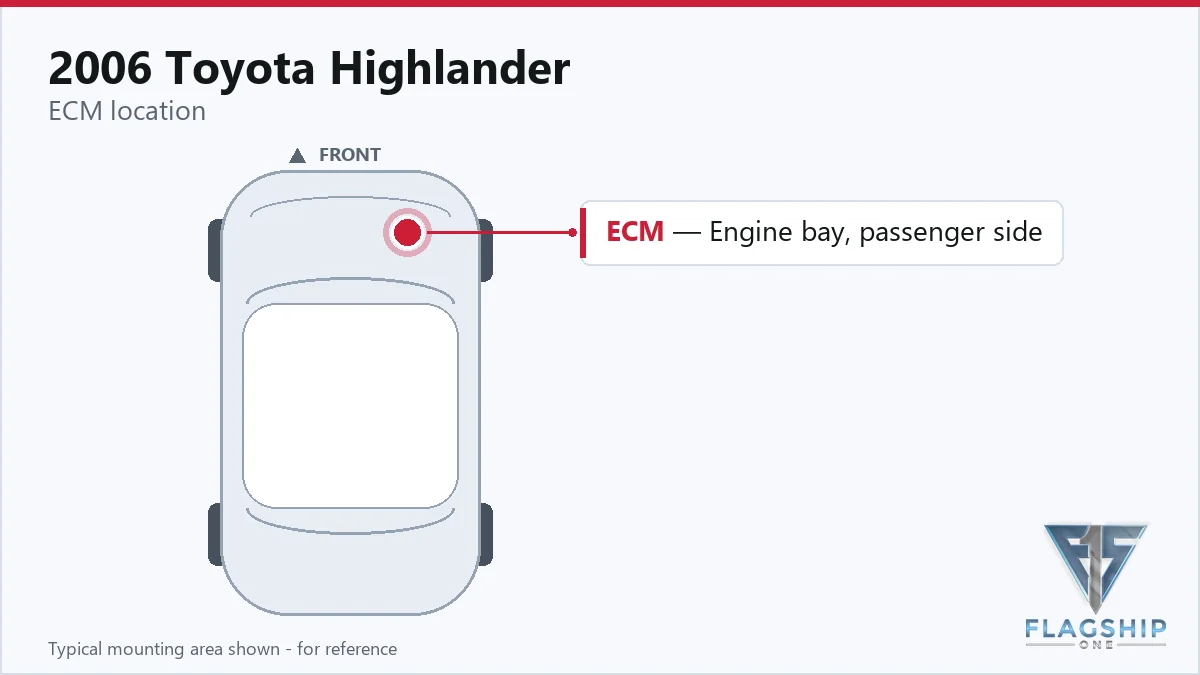
Work with the ignition off, and treat the module as static-sensitive: avoid touching the connector pins at any point.
| Operation | Configuration | Book Time |
|---|---|---|
| Engine Control Module Relearn | All configurations | 0.5 hr |
| Engine Control Module R&R | All configurations | 0.4 hr |
| Powertrain Control Module R&R | 3.3L | 0.4 hr |
| Powertrain Control Module R&R | 2.4L | 0.4 hr |
| Powertrain Control Module Relearn | All configurations | 0.5 hr |
Factory procedures mandate entering the vehicle identification number into the newly installed computer. Content updated on June 3, 2005, includes model years 2004 and 2006, noting that the Highlander HV was added to step four of the VIN write process. It is crucial to remember to program the VIN on these automobiles, as cars lacking VINs may fail certain state and local emissions testing requirements. On the majority of 2005 models, neglecting to write the VIN to the ECM or PCM produces an M code. You must program the VIN following the diagnostic tester screen prompts. If the writing process is not complete, or if the written VIN does not match, program the VIN a second time. Choosing a pre-programmed replacement unit from Flagship One bypasses these programming steps entirely, as the necessary vehicle identification data is already loaded.
When the main computer begins to fail in the 2006 Toyota Highlander, drivers often notice significant drivability disruptions. The engine may stall unexpectedly while idling or cruising, or it may crank without starting at all. Erratic shifting from the automatic transmission is another common indicator, as the unit struggles to coordinate gear changes properly. Sometimes, the diagnostic port fails to communicate with a scan tool, preventing technicians from reading live data. Internal circuitry failures frequently trigger specific diagnostic trouble codes. For example, an internal processor fault often points directly to a malfunction within the module itself rather than an external sensor issue. Misfire codes or random performance drops may also appear intermittently. Because these symptoms overlap with other ignition or fuel delivery problems, evaluating the computer for internal faults is crucial when standard diagnostics do not resolve the issue.
The following diagnostic trouble codes are specifically documented as module-internal faults for the 2006 Toyota Highlander. When these codes appear, they typically indicate that the internal circuitry of the computer has degraded, meaning the component usually requires replacement rather than external wiring repairs.
Toyota issued technical service bulletin SS002-07, applicable from January to August, outlining the Techstream electronic control unit flash reprogramming steps. This bulletin addresses how to properly update the software using the specific diagnostic tools required by the manufacturer. Following the specified reprogramming steps ensures the computer runs the latest calibration, which can sometimes resolve intermittent drivability concerns or communication errors without requiring complete hardware replacement. Checking for applicable bulletins before replacing the unit may save time and expense if a software update resolves the vehicle symptoms.
| Bulletin | Subject | What It Addresses |
|---|---|---|
| SS002-07 | :SS002-07: 01-08 Applicable Toyota: Techstream ECU Flash Reprogramming Procedure | — |
The book time for removing and reinstalling the powertrain control module on the 3.3L engine is 0.4 hours, with an additional 0.5 hours required for the relearn procedure.
The factory removal procedure places the control module behind the cowl side trim on the right side, requiring the removal of the glove compartment door and surrounding trim panels.
Yes, factory procedures mandate writing the VIN to the new module, as vehicles with missing VINs are subject to failing some state and local emissions inspection programs.
Deciding between repairing or replacing the computer in your 2006 Toyota Highlander involves weighing cost against reliability. While some shops offer repair services, internal circuitry degradation often makes a refurbished replacement a more dependable long-term solution. Choosing a unit that arrives ready to install eliminates the risks associated with botched repairs. Flagship One provides options specifically calibrated for the Highlander, ensuring proper engine management right out of the box.

Flagship One stocks a refurbished, VIN-programmed PCM for the 2006 Toyota Highlander with a lifetime warranty, free shipping and no core charge. The full Toyota Highlander module lineup covers other engine configurations as well.
Addressing powertrain control module failures in your 2006 Toyota Highlander promptly prevents cascading drivability issues and potential state emissions test failures. Understanding the specific replacement location, labor times, and programming requirements equips you to handle the entire repair process efficiently. When internal electrical faults compromise your vehicle, exploring reliable replacement options restores your confidence and gets your Highlander back on the road smoothly.