
Last updated on August 25th, 2026 at 01:03 pm
The Powertrain Control Module (PCM) on your 2005 Mercury Montego is the central computer managing engine timing, fuel delivery, emissions, and transmission shifting. When this module fails internally, it typically sets multiple module-specific DTCs and leaves the vehicle inoperable.
If your 2005 Mercury Montego has stopped running or is setting multiple internal trouble codes, the Powertrain Control Module is often the root cause. This guide explains what the PCM does, where it lives, what failure looks like, and what replacement involves. Whether you are diagnosing a no-start condition or comparing repair options, you will find clear, factual information here. The goal is to help you understand the scope of the job and make informed decisions withoutguesswork or sales pressure.
The Powertrain Control Module on your 2005 Mercury Montego serves as the brain of the engine management system. It processes inputs from dozens of sensors to control fuel injection, ignition timing, emissions systems, and automatic transmission shifting. Unlike simple sensor failures that trigger individual circuit codes, internal PCM deterioration produces a characteristic pattern of module-specific trouble codes — P0600-series codes for memory integrity, P0650-series codes for processor voltage references, and U-codes for lost communication with other control modules. When the PCM fails in this manner, the vehicle typically exhibits no-start, stalling, or limp-mode operation that persists regardless of sensor replacement. The module essentially loses its ability to process data reliably, making repair of individual circuits futile. Replacement with a properly programmed unit restores full functionality. You can find replacement engine computers for the Montego from suppliers that stock model-specific units ready for installation.
Flagship One keeps Mercury Montego replacement engine computers in stock for exactly this failure pattern.
The factory service documentation places the powertrain control module for the 2005 Mercury Montego in the Engine Compartment. Access typically requires removing surrounding components to reach the unit mounted on the firewall or inner fender panel. The book time for PCM removal and installation is 1.4 hours, with an additional 0.5 hour allocated for the relearn procedure that follows any replacement. Technicians also budget 0.5 hour for powertrain control system diagnosis and testing to verify the fault and confirm the repair. Replacement involves disconnecting the battery, removing the old module, transferring the mounting hardware and connectors, installing the new unit, and then performing the relearn procedure to establish communication with the vehicle’s systems. All connectors should be inspected for corrosion or damaged pins before reassembly.
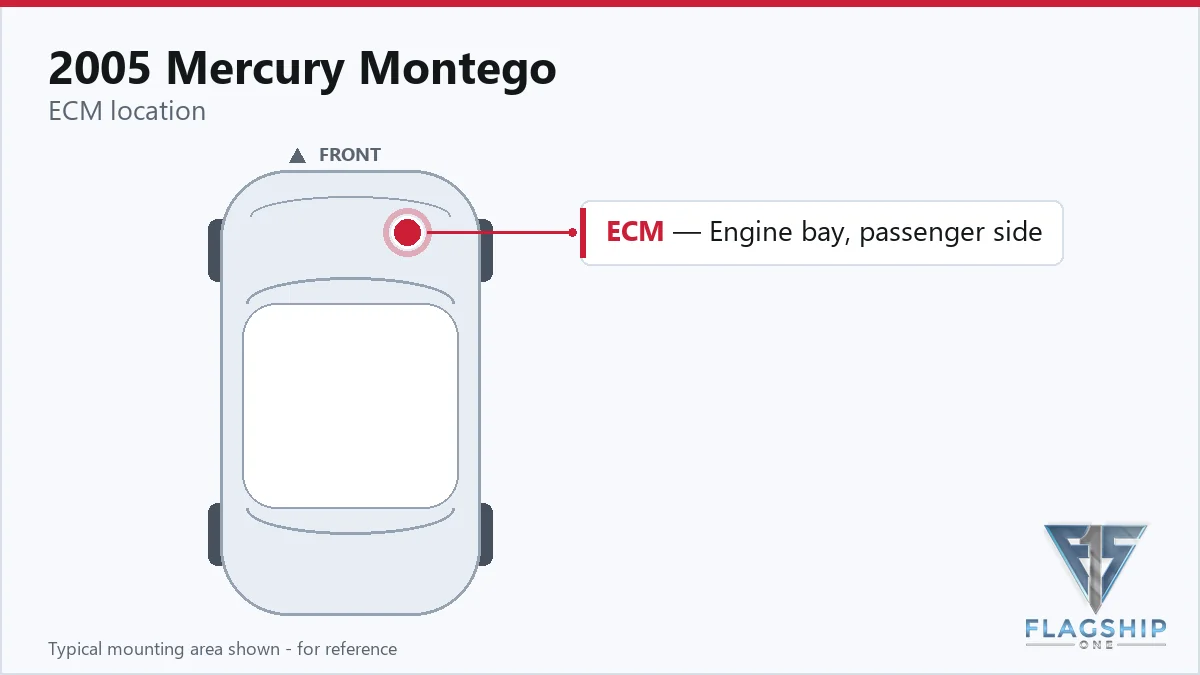
Work with the ignition off, and treat the module as static-sensitive: avoid touching the connector pins at any point.
| Operation | Configuration | Book Time |
|---|---|---|
| Engine Control Module Relearn | All configurations | 0.5 hr |
| Engine Control Module R&R | All configurations | 1.4 hr |
| Powertrain Control System Diagnosis & Testing | All configurations | 0.5 hr |
2005 Mercury Montego
OEM programmed ECM for your 2005 Mercury Montego — plug & play, no dealer visit.
Free shipping · Lifetime warranty
After replacing the PCM on your 2005 Mercury Montego, the passive anti-theft system (PATS) requires factory reprogramming to allow the new module to communicate with the vehicle’s security system. This is a mandatory step — without proper PATS initialization, the engine will crank but not start. The procedure involves using dealer-level scan tooling to program the new module with the vehicle’s unique VIN and security calibration. However, when you purchase a VIN-programmed replacement unit from Flagship One, the module arrives pre-configured for your specific Montego. This means the PATS programming is already completed before the unit reaches you, saving the dealer visit and associated labor costs that would otherwise be required.
Every VIN-programmed replacement unit from Flagship One arrives with these steps already completed.
When the PCM on a 2005 Mercury Montego fails internally, the symptoms tend to follow a recognizable pattern. The most common presentation is a no-start condition where the engine cranks normally but fails to fire, often accompanied by multiple DTCs that cannot be cleared. Some vehicles experience intermittent stalling or rough idle that worsens as the module’s condition deteriorates. Misfire codes affecting individual cylinders may appear and persist despite replacing spark plugs, wires, or coils. In many cases, scan tools cannot communicate with the PCM at all, or communication drops out repeatedly. Transmission shifting may become erratic or the vehicle may default to limp mode. The presence of internal codes like P0601 often indicates EEPROM failure within the module itself, signaling that replacement is the only viable solution rather than continued sensor troubleshooting.
The 2005 Mercury Montego with a failed PCM frequently exhibits a specific cluster of module-internal trouble codes. These codes indicate problems within the control module rather than faults in external circuits, and their presence confirms that module replacement is the appropriate repair.
Factory service bulletins for the 2005 Mercury Montego 3.0L address several known issues. TSB 07-05-01 covers MIL illumination with multiple coil DTC codes on the 3.0L four-valve engine. TSB 07-04-07 addresses fuel rail pressure sensor circuit performance problems that trigger DTC P0191 and MIL illumination. While these bulletins describe sensor and circuit concerns, the presence of internal module codes alongside these symptoms often points to PCM failure as the underlying cause rather than repeated sensor replacements.
| Bulletin | Subject | What It Addresses |
|---|---|---|
| 07-05-01 | 3.0L 4V – MIL ON – WITH MULTIPLE COIL DTC CODES | — |
| 07-04-07 | FUEL RAIL PRESSURE SENSOR CIRCUIT PERFORMANCE – MIL ON WITH DTC P0191 | — |
No. The PCM must be matched to your vehicle’s VIN and PATS calibration. A mismatched module will either not start the engine or trigger security lockout. Purchasing a VIN-programmed replacement ensures plug-and-play compatibility.
Technically yes, but the job requires basic electrical knowledge and patience. The challenge lies in accessing the module in the engine compartment, transferring connectors without damage, and performing the relearn procedure. If the replacement unit is not pre-programmed, PATS initialization also requires dealer tooling.
If your scan tool reveals multiple P0600-series, P0650-series, or U-codes that return immediately after clearing, the PCM itself has failed. Sensor codes alone typically indicate external problems. When internal codes appear alongside multiple system failures, module replacement is the most cost-effective path forward.
When your 2005 Mercury Montego requires a new PCM, you have two primary options: repair the existing module or install a refurbished replacement. Repair involves diagnosing and rebuilding the original unit, which can be cost-effective but carries no warranty guarantee. A refurbished replacement from a reputable supplier typically comes with a warranty and arrives ready to install. Given the PATS programming requirement and the Montego’s specific calibration, sourcing a unit pre-configured with your VIN eliminates the dealer programming step and gets you back on the road faster.
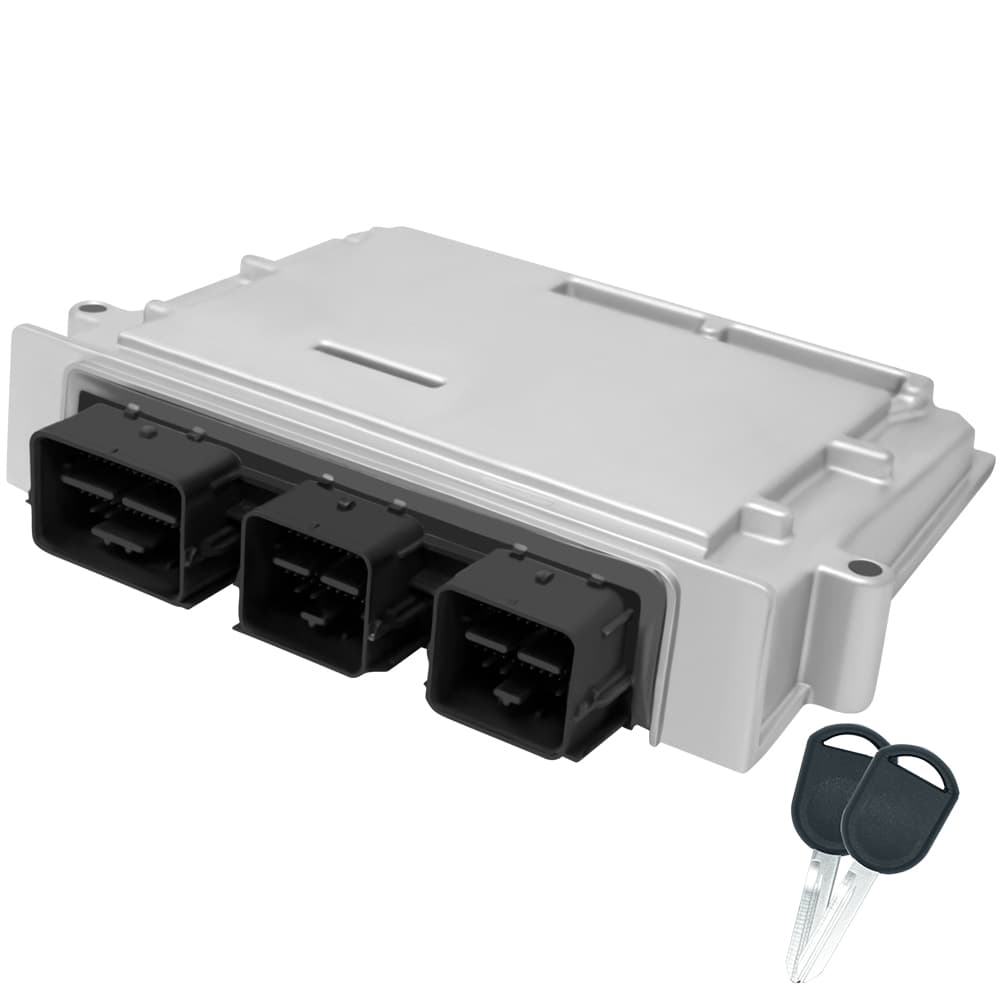
Flagship One stocks a refurbished, VIN-programmed PCM for the 2005 Mercury Montego with a lifetime warranty, free shipping and no core charge. The full Mercury Montego module lineup covers other engine configurations as well.
The 2005 Mercury Montego relies on a robust PCM to manage its 3.0L engine and transmission. When internal codes appear, module replacement is typically the most practical solution. By understanding the location, programming requirements, and failure patterns, you can approach the repair with confidence. Whether you choose a professional install or tackle it yourself, a properly programmed replacement restores reliable operation to your Montego.