
Last updated on August 25th, 2026 at 01:53 pm
The Powertrain Control Module (PCM) in your 2004 Mitsubishi Montero manages engine performance and transmission behavior. A failing PCM may disrupt fuel delivery, ignition timing, or shift patterns, leading to drivability issues or complete breakdowns.
If your 2004 Mitsubishi Montero has been acting unpredictably—stalling at stops, refusing to start, or throwing cryptic check-engine lights—you may be dealing with a failing Powertrain Control Module (PCM). This small but critical computer oversees everything from fuel injection to transmission shifts, and when it malfunctions, your vehicle’s performance suffers. Replacing it isn’t just about swapping a part; it involves precise labor steps and a factory-required relearn procedure to ensure everything communicates correctly. Understanding the process helps you avoid unnecessary delays or repeat repairs. Whether you’re a DIYer or working with a shop, knowing what to expect with the PCM in your Montero can save time, frustration, and even money. This guide covers the module’s role, common failure symptoms, replacement steps, and why a pre-programmed unit simplifies the job.
The Powertrain Control Module (PCM) in your 2004 Mitsubishi Montero serves as the brain of the engine and transmission systems. It continuously monitors sensors for data like air intake, throttle position, and engine temperature, then adjusts fuel delivery, ignition timing, and shift points in real time. Without a functioning PCM, your vehicle may struggle to start, run inefficiently, or even enter a failsafe mode that limits performance. Over time, heat, vibration, or voltage spikes can degrade the module’s internal circuits, leading to intermittent or permanent failures. When replacement becomes necessary, you’ll need replacement engine computers for the Montero that match your vehicle’s original specifications. The PCM’s location and design make it accessible for service, but its role in coordinating multiple systems means even minor issues can have noticeable effects on drivability.
2004 Mitsubishi Montero
OEM programmed replacements — plug & play, no dealer visit.
Find yours by year, make & model →
Free shipping · Lifetime warranty
In the 2004 Mitsubishi Montero, the PCM is mounted inside the engine bay, typically secured near the firewall or fender well for protection from moisture and debris. Replacing it involves disconnecting the battery, removing the electrical connectors, and unbolting the module from its bracket. The factory labor time for Powertrain Control Module removal and reinstallation is 0.6 hours. Once the old unit is out, the new PCM is bolted into place, and connectors are reattached. No special tools are required beyond basic hand tools, but care must be taken to avoid damaging the connectors or pins during the swap. The process is straightforward, but the module’s position may require working around other components in the engine compartment.
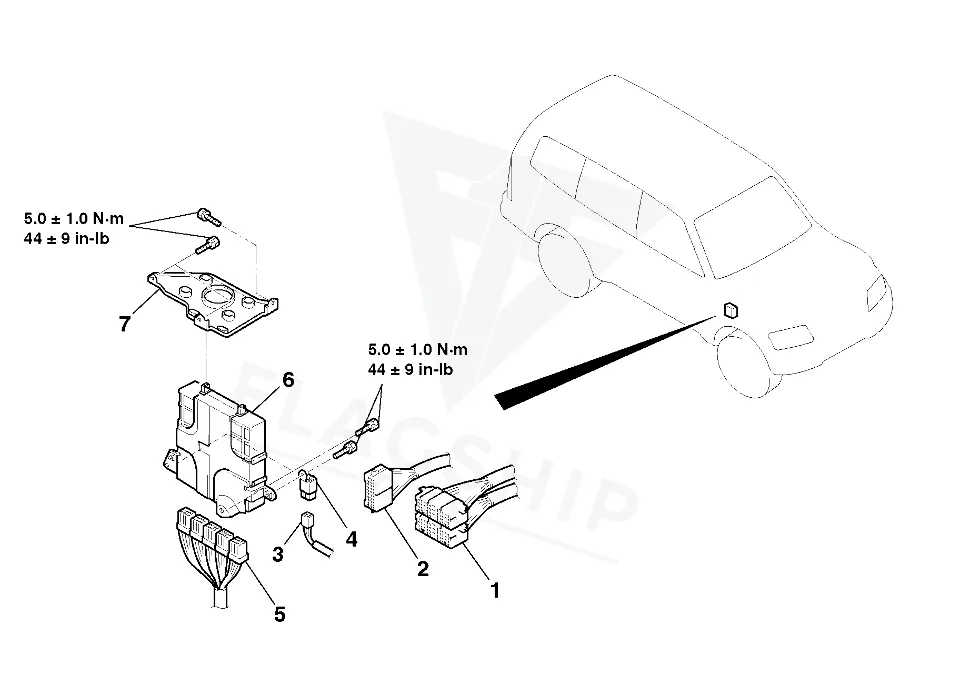
Work with the ignition off, and treat the module as static-sensitive: avoid touching the connector pins at any point.
| Operation | Configuration | Book Time |
|---|---|---|
| Powertrain Control Module R&R | All configurations | 0.6 hr |
| Powertrain Control Module Relearn | All configurations | 0.5 hr |
| Engine Control Module Relearn | All configurations | 0.5 hr |
| Engine Control Module R&R | All configurations | 0.6 hr |
After installing a new PCM in your 2004 Mitsubishi Montero, the factory procedure requires a relearn process to synchronize the module with the vehicle’s other systems. This typically involves a 0.5-hour procedure, often performed with a scan tool to reset adaptive values and ensure proper communication with the engine and transmission. However, when you use a VIN-programmed replacement unit, this step is already completed before the part arrives. The module is pre-configured to match your Montero’s specific calibration, eliminating the need for dealer reprogramming or additional labor. This not only saves time but also reduces the risk of errors during the relearn process, ensuring your vehicle operates as intended from the first start.
A failing PCM in your 2004 Mitsubishi Montero may produce a range of symptoms, often starting with subtle drivability issues before escalating to more severe problems. You might notice the engine stalling at idle, hesitating during acceleration, or failing to start altogether. Transmission shifts may feel harsh or delayed, and the check-engine light could illuminate with codes like an internal processor fault. In some cases, the vehicle may enter a limp-home mode, limiting speed or power to prevent further damage. Scan tool communication with the PCM may also fail, making diagnosis more challenging. These symptoms often worsen over time, so addressing them promptly can prevent being stranded or dealing with more extensive repairs later. If you experience multiple issues simultaneously, the PCM is a likely culprit, especially if other common causes like fuel or ignition problems have been ruled out.
The 2004 Mitsubishi Montero’s PCM may store specific trouble codes when internal faults are detected. These codes help pinpoint the source of drivability issues and guide the repair process. Below are the documented module-internal codes for this vehicle.
| Code | Meaning | Full Guide |
|---|---|---|
| P0606 | Module processor failure | Full P0606 guide → |
While the vehicle may still run, a P0606 code indicates an internal PCM fault that could lead to stalling or no-start conditions. Driving with this issue may cause further drivability problems or leave you stranded. It’s best to address it promptly to avoid unexpected breakdowns.
A failing PCM often causes multiple symptoms at once, such as stalling, misfires, and transmission issues. If basic checks like fuel pressure, spark, and sensors don’t reveal problems, the PCM may be the culprit. A scan tool can confirm by checking for module-internal codes or communication failures.
No, but the factory requires a relearn procedure after installation, which typically takes 0.5 hours. Using a VIN-programmed replacement unit eliminates this step, allowing you or your shop to complete the job without dealer involvement.
Common causes include voltage spikes from a failing alternator or jump-starting, corrosion in electrical connectors, and prolonged exposure to heat or moisture. Age-related wear can also degrade the module’s internal circuits over time.
Yes, if you’re comfortable working with electrical components. The process involves disconnecting the battery, removing connectors, and unbolting the module. However, if the new unit isn’t pre-programmed, you’ll need a scan tool to perform the relearn procedure afterward.
When your 2004 Mitsubishi Montero’s PCM fails, you have two main options: repair the existing unit or replace it with a new or refurbished module. Repairs may work for minor issues, but they often don’t address underlying circuit degradation. A replacement unit ensures reliability, especially if it’s pre-programmed to your VIN, saving you the hassle of a dealer visit for reprogramming. Given the labor involved, choosing the right part upfront can make the difference between a smooth repair and repeated trips to the shop.
Flagship One stocks a refurbished, VIN-programmed PCM for the 2004 Mitsubishi Montero with a lifetime warranty, free shipping and no core charge. The full Mitsubishi Montero module lineup covers other engine configurations as well.
The PCM in your 2004 Mitsubishi Montero plays a critical role in keeping your vehicle running smoothly. When it fails, symptoms like stalling, no-start conditions, or transmission issues can disrupt your daily routine. Replacing it involves straightforward labor, but the factory-required relearn procedure adds complexity—unless you opt for a VIN-programmed unit. By understanding the process and addressing issues early, you can avoid unexpected breakdowns and keep your Montero reliable for years to come.