
Last updated on August 25th, 2026 at 01:59 pm
The Engine Control Module (ECM) and Powertrain Control Module (PCM) serve as the primary computer for your 2004 Mazda MX-5 Miata, managing fuel delivery, ignition timing, emissions controls, and sensor inputs. When internal circuitry fails, your Miata may display warning lights, run poorly, or fail to start entirely.
If your 2004 Mazda MX-5 Miata is running rough, refusing to start, or displaying warning lights you cannot explain, the Engine Control Module or Powertrain Control Module may be the culprit. These onboard computers manage the complex dance between your engine’s sensors and actuators, constantly adjusting for conditions that change moment by moment. The Miata’s 1.8L engine, while generally reliable, depends heavily on precise electronic control for smooth operation. When the ECM or PCM fails internally, symptoms can range from subtle drivability issues to complete no-start conditions. Understanding what these modules do, where they live in your Miata, and what replacement involves helps you make informed decisions about repair versus replacement. This guide covers everything you need to know about these critical control units for your specific vehicle.
The Powertrain Control Module in your 2004 Mazda MX-5 Miata functions as the central nervous system for your engine management. This computer receives data from dozens of sensors throughout your 1.8L powerplant, including the mass airflow sensor, crankshaft position sensor, camshaft position sensor, and oxygen sensors. It processes this information millions of times per minute, commanding the fuel injectors, ignition coils, and variable valve timing components to deliver optimal power and efficiency under all driving conditions. The ECM specifically handles emissions control logic, ensuring your Miata meets federal standards for exhaust gases. Mazda designed these modules with internal memory that can degrade over time from heat cycles, voltage stress, or manufacturing defects in the circuitry. When internal failures occur, the module may send incorrect commands to your engine or simply stop communicating entirely. For owners seeking replacement engine computers for the Miata, understanding this critical role helps explain why symptoms can affect nearly every aspect of engine operation when the module fails.
2004 Mazda MX-5 Miata
OEM programmed ECM for your 2004 Mazda MX-5 Miata — plug & play, no dealer visit.
Free shipping · Lifetime warranty
The Engine Control Module on your 2004 Mazda MX-5 Miata with the 1.8L engine mounts on the firewall in the engine compartment on the passenger side. Access requires removing the engine cover and potentially the battery or battery tray depending on your specific configuration. The module sits in a protective housing that must be unbolted from its mounting bracket before disconnecting the electrical harness. Labor estimates from professional guides indicate 0.5 hours for replacement on vehicles without immobilizer systems and 0.8 hours for those equipped with immobilizer functionality. An additional 0.5 hours accounts for the required relearn procedure that follows installation. The replacement process involves carefully transferring mounting hardware to the new module and ensuring all electrical connections seat fully before restoring power.
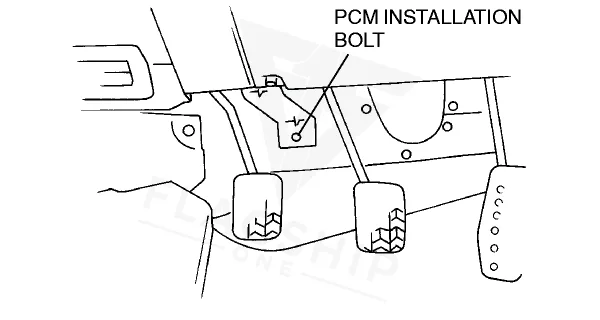
Work with the ignition off, and treat the module as static-sensitive: avoid touching the connector pins at any point.
| Operation | Configuration | Book Time |
|---|---|---|
| Powertrain Control Module R&R | Without Immobilize System | 0.5 hr |
| Powertrain Control Module R&R | With Immobilize System | 0.8 hr |
| Powertrain Control Module Relearn | All configurations | 0.5 hr |
| Engine Control Module R&R | Without Immobilize System | 0.5 hr |
| Engine Control Module R&R | With Immobilize System | 0.8 hr |
| Engine Control Module Relearn | All configurations | 0.5 hr |
After physically installing a replacement ECM or PCM in your 2004 Mazda MX-5 Miata, the factory service procedure requires performing a module relearn process. This procedure allows your vehicle’s systems to recognize the new module and calibrate to its specific programming parameters. The relearn typically involves a specific driving cycle or use of dealer-level diagnostic equipment to complete the adaptation process. Depending on your specific configuration, this step may require dealer involvement if you lack the proper scan tool capabilities. Flagship One addresses this requirement by shipping a VIN-programmed replacement unit that arrives configured for your specific vehicle identification number, eliminating much of the post-installation programming complexity that would otherwise require dealer service.
When the ECM or PCM fails on your 2004 Mazda MX-5 Miata, you may notice one or several symptoms appearing simultaneously or progressing over time. A no-start condition occurs when the module fails to provide ignition spark or fuel injector pulse commands to the engine. Intermittent stalling or rough idle suggests the module is receiving sensor data but processing it incorrectly or dropping signals entirely. Misfire codes appearing across multiple cylinders often indicate module communication problems rather than individual component failures. Your scan tool may show no communication with the ECM when the module loses internal processing capability entirely. Transmission shifting problems can result from a failing module because the PCM controls line pressure and shift scheduling on automatic-transmission models. Many of these symptoms overlap with failing sensors, making thorough diagnosis essential before assuming the computer itself is at fault. When the check engine light illuminates and fault code P2004 appears, it may indicate an intake manifold runner position malfunction that the computer is logging intake manifold performance issue due to related sensor interactions.
Mazda issued factory service bulletin 01 055/06 specifically covering 2004 and 2005 Miata vehicles experiencing MIL illumination with P2004 set after starting the engine. This bulletin addresses a known condition where the intake manifold runner position sensor or related circuits cause false fault detection. Additionally, bulletin 07 002/09 covers musty or mildew odors from the air conditioning system across multiple Mazda models including the Miata, which though not directly related to ECM operation, demonstrates Mazda’s ongoing attention to this generation’s comfort systems. These bulletins provide technicians with specific diagnostic and repair procedures for the conditions they describe.
| Bulletin | Subject | What It Addresses |
|---|---|---|
| — | 07 002/09 Multi Model Air Conditioning Musty / Mildew Odor | — |
| — | 01 055/06 2004 2005 Miata, 2004 2005 Mazdaspeed Mx 5 MIL On / P2004 Sets After Starting Engine | — |
The immobilizer system integrates with your Miata’s PCM to prevent unauthorized engine starting. Vehicles equipped with this security feature require additional labor during replacement to handle coded key relearning. You can typically identify immobilizer-equipped models by checking for a blinking security light on the instrument cluster when the ignition is off.
Yes, voltage irregularities from a struggling charging system can mimic ECM failure symptoms including stalling, no-start conditions, and fault code storage. Before replacing your control module, verifying battery condition, alternator output, and ground circuit integrity helps avoid misdiagnosis and unnecessary replacement costs.
A used module from another vehicle will not communicate properly with your specific Miata’s sensors and actuators without VIN programming or relearn procedures. Even if installed, you may experience non-start conditions, shifting problems, or illuminated warning lights because the module contains calibration data specific to a different vehicle identification number.
Intermittent communication loss between your scan tool and the ECM often indicates loose connectors, corroded terminals, or internal module problems that worsen with heat cycling. If communication drops out only after the engine warms up, temperature-related failures within the module circuitry may be developing.
The P2004 code indicates intake manifold runner position sensor performance issues and may involve the manifold actuator mechanism rather than the PCM directly. However, persistent P2004 codes that return after sensor replacement sometimes indicate the ECM is receiving conflicting data or has developed internal processing faults affecting its interpretation of sensor signals.
Repairing your 2004 Mazda MX-5 Miata’s ECM or PCM involves weighing remanufactured versus new replacement options, each with distinct advantages. Remanufactured units offer cost savings while replacing a failed module with a new OEM unit provides maximum reliability at higher expense. Your specific circumstances, including whether your current module can be diagnosed definitively as failed, should guide this decision. Flagship One provides VIN-programmed replacement units configured specifically for your Miata, helping streamline what could otherwise become a complex repair process.
Flagship One stocks a refurbished, VIN-programmed PCM for the 2004 Mazda MX-5 Miata with a lifetime warranty, free shipping and no core charge. The full Mazda MX-5 Miata module lineup covers other engine configurations as well.
The ECM and PCM in your 2004 Mazda MX-5 Miata represent the heart of your vehicle’s engine management system, and their reliable operation determines how well your car runs in all conditions. Understanding the symptoms of module failure, the replacement process, and the programming requirements helps you approach diagnosis and repair with confidence. Whether you ultimately choose repair or replacement, being an informed consumer protects your investment in your Miata.