
Last updated on August 25th, 2026 at 02:44 pm
The engine control module in the 2003 BMW Z8 manages fuel delivery, ignition timing, and emissions controls. Failure of this unit can interrupt engine management, trigger the Check Engine Light, and store diagnostic trouble codes that prevent normal operation.
When a 2003 BMW Z8 displays a persistent Check Engine Light, the underlying cause is frequently linked to the engine control module. This electronic brain governs critical engine functions, and any disruption can lead to performance loss and diagnostic trouble codes. Understanding how the module operates, where it is located, and what factory procedures apply helps you decide whether a repair or a refurbished replacement is the best path forward. This guide walks you through the module’s role, typical symptoms of failure, the factory reprogramming requirement, and practical steps to protect the unit after installation.
2003 BMW Z8
OEM programmed ECM for your 2003 BMW Z8 — plug & play, no dealer visit.
Free shipping · Lifetime warranty
In the 2003 BMW Z8, the engine control module—often referred to as the DME or ECM—coordinates fuel injection, spark timing, and emission controls to keep the V8 running smoothly. It receives input from a network of sensors and sends commands to actuators, ensuring the engine meets performance and emissions standards. Because the Z8 relies on precise timing for its 4.9L powerplant, any loss of communication can cause rough idle, misfires, or a complete no‑start condition. The module also stores diagnostic information that technicians use to pinpoint issues. When the unit fails, the vehicle may lose OBD communication, triggering the Check Engine Light and storing fault codes. The module’s importance is underscored by the factory recall that mandates reprogramming to restore OBD functionality. For owners seeking a new unit, replacement engine control modules for the 2003 BMW Z8 provide a direct swap while preserving the vehicle’s calibrated performance.
The factory removal procedure reaches the engine control module inside the electronics box, commonly called the E‑box, which sits in the engine compartment of the 2003 BMW Z8. Access typically requires opening the hood, removing the cover that protects the E‑box, and disconnecting the module’s electrical connector. Replacement involves extracting the original unit and installing the new module in the same mounting location, ensuring the connector engages fully. After mechanical installation, the connector seal should be inspected for damage to maintain a reliable waterproof interface.
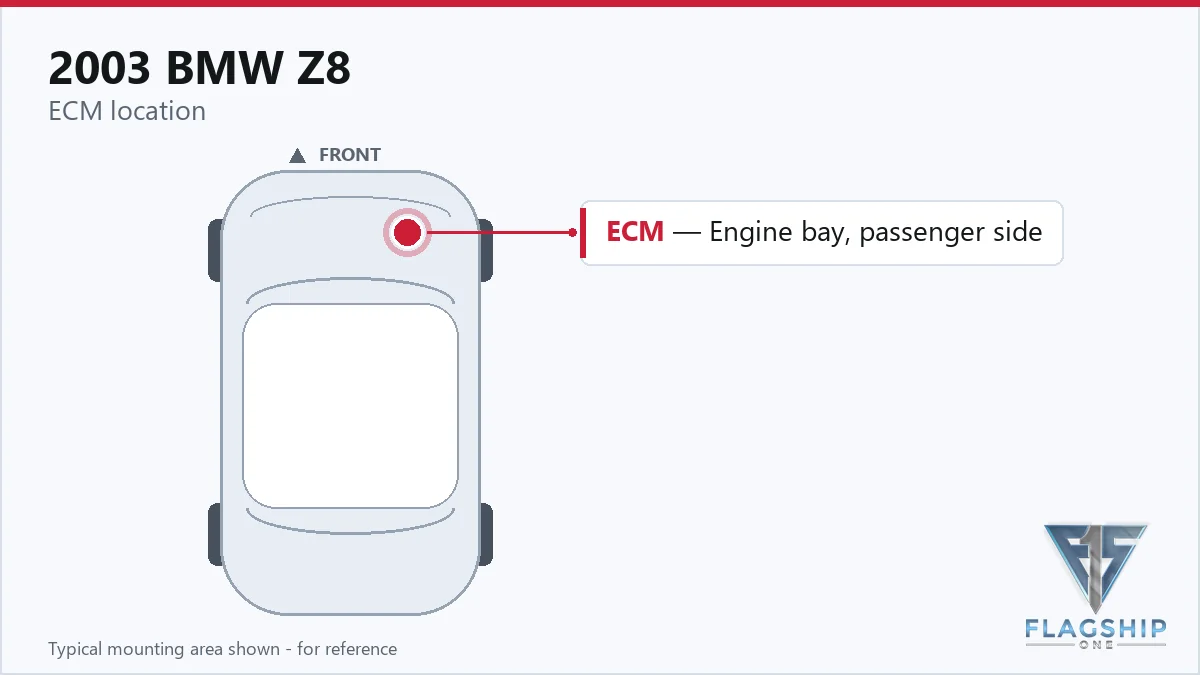
Work with the ignition off, and treat the module as static-sensitive: avoid touching the connector pins at any point.
Following replacement, the factory service bulletin 06E‑A03 calls for a DME reprogramming step to re‑establish OBD communication. Flagship One units arrive pre‑configured for the vehicle’s VIN, so the required reprogramming is already completed. This means the installer can focus on the physical swap without additional coding, as a VIN-programmed replacement unit eliminates the need for post‑install software updates.
A failing engine control module in the 2003 BMW Z8 may present as an illuminated Check Engine Light, loss of power, or intermittent stalling. Drivers often notice rough idle, misfire events, or an inability to start the engine altogether. Diagnostic trouble codes stored in the DME can include communication errors such as clock signal error, which indicate the module is not exchanging data correctly with other vehicle systems. In some cases, the vehicle may exhibit unexpected shifting behavior because the ECM also informs the transmission control unit of engine speed and load.
Recall 06E‑A03 addresses DME reprogramming needed for OBD communication. Additionally, a service bulletin notes that a Check Engine Light may illuminate with faults stored in the DME/ECM, prompting the reprogramming step.
| Bulletin | Subject | What It Addresses |
|---|---|---|
| — | Recall 06E-A03: S62,S54 – DME Reprogramming for OBD Communication | — |
| — | Check Engine Light Illuminated, Faults Stored in DME/ECM | — |
The light often stays illuminated when the ECM detects communication errors or stores fault codes, such as those addressed by recall 06E‑A03. A failing module or corrupted software can trigger this condition.
Replacement generally requires standard hand tools to remove the E‑box cover and disconnect the electrical connector. No specialized programming equipment is needed if you use a VIN‑programmed unit.
A refurbished unit that is VIN‑programmed can restore OBD communication, provided it matches the vehicle’s specifications and the factory reprogramming step is satisfied.
The recall mandates a DME reprogramming after module replacement. Using a Flagship One VIN‑programmed replacement satisfies this requirement without additional coding steps.
Driving with a malfunctioning ECM can lead to reduced performance, stalling, or further damage, so it’s advisable to address the issue promptly.
When the engine control module in your 2003 BMW Z8 needs attention, you can choose between a repair or a refurbished replacement. A Flagship One unit offers a VIN‑programmed solution that aligns with factory requirements, allowing you to restore proper engine management without extra coding steps. Consider the condition of your current module and the availability of a calibrated replacement to decide the best path forward.
Flagship One stocks a refurbished, VIN-programmed ECM for the 2003 BMW Z8 with a lifetime warranty, free shipping and no core charge. The full BMW Z8 module lineup covers other engine configurations as well.
The 2003 BMW Z8’s engine control module is essential for reliable performance. Whether you opt for repair or a VIN‑programmed replacement, ensuring proper installation and protection will help keep your Z8 running smoothly. Contact a qualified technician to evaluate your options.