
Last updated on August 25th, 2026 at 01:01 pm
In the 2001 Audi TT, the Engine Control Module (ECM) and Powertrain Control Module (PCM) manage engine timing, fuel delivery, and transmission coordination. Failure typically results from electrical faults, water intrusion, or internal component wear, leading to loss of driveability and diagnostic communication.
When a 2001 Audi TT exhibits intermittent power loss, unexpected stalling, or a complete no‑start condition, the vehicle’s electronic control strategy often points to the Engine or Powertrain Control Modules. These computers act as the brain of the powertrain, interpreting sensor data and directing actuators to keep the engine running smoothly and the transmission shifting correctly. Understanding how the modules function, where they reside, and what service steps are required can help you decide whether a repair or a replacement is the most efficient path. This guide walks you through the role of each module, typical failure signs, the labor involved in removal and installation, and how Flagship One’s pre‑programmed units simplify the process.
2001 Audi TT
OEM programmed ECM for your 2001 Audi TT — plug & play, no dealer visit.
Free shipping · Lifetime warranty
The Engine Control Module in a 2001 Audi TT processes inputs from dozens of sensors to regulate ignition timing, fuel injection, and emission controls, while the Powertrain Control Module extends that oversight to the transmission, ensuring gear changes match engine speed and load. Together they provide the coordinated performance expected from a sporty roadster, and any disruption can cause rough idle, loss of power, or transmission‑related error codes. Because the TT relies on precise timing and torque management, a malfunctioning module may lead to drivability issues that feel like intermittent misfires or sudden limp‑mode activation. The module’s firmware also stores adaptive strategies that evolve with engine wear, so a fresh 2001 Audi TT engine control module can restore original performance characteristics while preserving emission compliance.
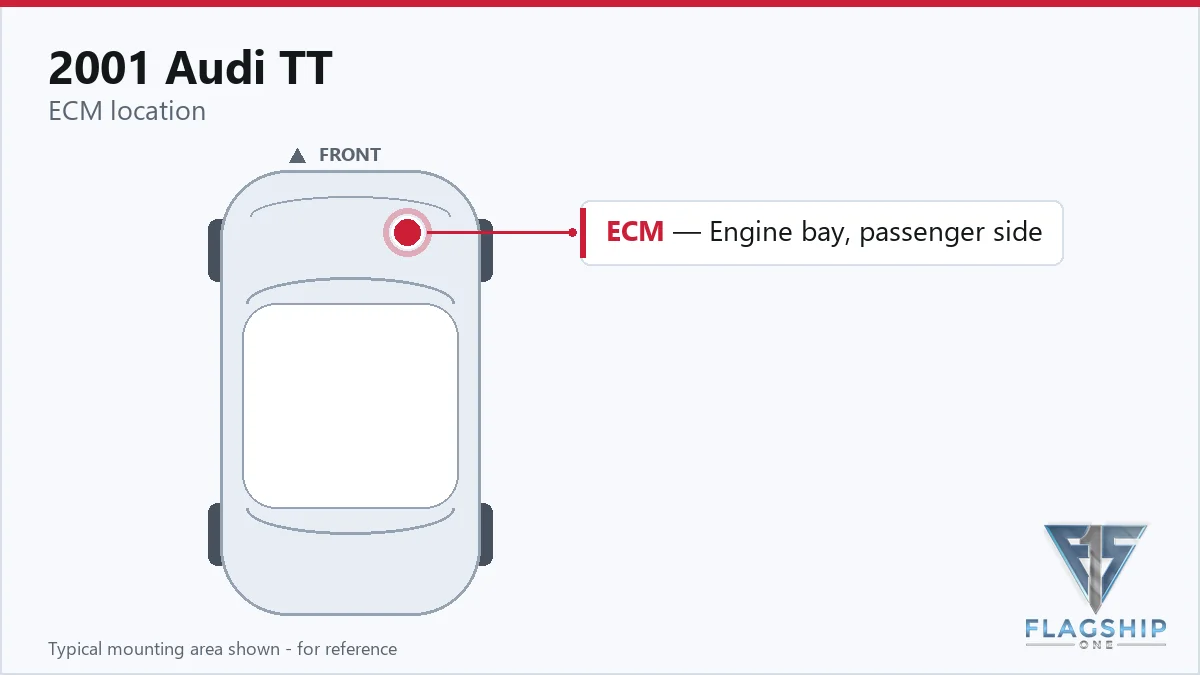
Both the ECM and PCM are mounted within the rear final drive, positioned toward the front‑right side of the housing. Access typically involves removing the rear differential cover to expose the control module area, then disconnecting the electrical connector and any securing bolts. The factory book time for removing and reinstalling either module on the TT is listed as 0.7 hours for a remove‑and‑replace operation and 0.5 hours for a relearn procedure. After the module is secured, the connector is reattached, and the differential cover is replaced, completing the physical installation before any software steps are performed.
| Operation | Configuration | Book Time |
|---|---|---|
| Engine Control Module Relearn | TT | 0.5 hr |
| Engine Control Module Relearn | TT Quattro | 0.5 hr |
| Engine Control Module R&R | TT | 0.7 hr |
| Engine Control Module R&R | TT Quattro | 0.7 hr |
| Powertrain Control Module R&R | TT | 0.7 hr |
| Powertrain Control Module R&R | TT Quattro | 0.7 hr |
| Powertrain Control Module Relearn | TT | 0.5 hr |
| Powertrain Control Module Relearn | TT Quattro | 0.5 hr |
Once the module is physically installed, the factory service guide calls for a relearn process that takes roughly half an hour to synchronize the new unit with the vehicle’s existing sensors and transmission parameters. Flagship One supplies a a VIN-programmed replacement unit that arrives already matched to your vehicle’s identification, so the relearn step is effectively completed during manufacturing, eliminating the need for on‑site programming and reducing labor time.
Owners of a 2001 Audi TT may notice a range of issues when the control modules begin to fail, including a complete lack of engine start, irregular idle, sudden stalling, or erratic gear shifts that feel out of sync with acceleration. Diagnostic scans often reveal communication errors such as communication fault or related powertrain codes, indicating that the module is not responding correctly to the vehicle’s data bus. In some cases, the check engine light flashes intermittently, and the driver may experience reduced power output as the system defaults to a protective mode to prevent damage.
Yes, the ECM controls fuel and ignition timing, so a malfunction can lead to sudden stalling, especially under load or during rapid acceleration.
Not always; if diagnostics isolate a problem to one module, only that unit needs replacement. However, simultaneous failure is possible because they share the same location and environmental exposure.
The labor guide lists 0.7 hours for removal and installation, plus an additional 0.5 hours for the required relearn procedure.
The unit arrives pre‑matched to your vehicle, which removes the need for on‑site programming, though a brief relearn verification may still be performed by the shop.
Codes related to transmission control, such as P0601 communication faults, often point to PCM issues, along with any codes that reference loss of communication with the engine control network.
When the control module in your 2001 Audi TT no longer performs reliably, you can choose a professional repair or opt for a refurbished replacement. A refurbished unit that matches factory specifications can restore original function without the cost of a brand‑new part, while still providing the necessary reliability for daily driving.
Flagship One stocks a refurbished, VIN-programmed PCM for the 2001 Audi TT with a lifetime warranty, free shipping and no core charge. The full Audi TT module lineup covers other engine configurations as well.
Understanding how the Engine and Powertrain Control Modules affect your 2001 Audi TT helps you make informed decisions about service. Whether you pursue a repair or a Flagship One replacement, addressing the issue promptly will keep your TT performing as intended.