
Last updated on August 25th, 2026 at 11:52 am
The engine control module in the 1999 Volkswagen Jetta manages fuel injection and oxygen sensor regulation. When this computer fails, it often triggers internal fault codes or causes drivability problems, requiring replacement to restore proper engine performance.
When a 1999 Volkswagen Jetta develops drivability issues or illuminates warning lights, the engine control module often becomes a suspect. This critical computer dictates how the fuel injection and emissions systems operate. Understanding what this component does, where it is located, and how to address its failure can save you time and money. Whether you are troubleshooting a check engine light or preparing for a repair, knowing the specifics of your vehicle’s computer system empowers you to make informed decisions. This guide covers the essential details regarding the Jetta’s engine management computer, including factory service times, common symptoms, and relevant technical bulletins. By grasping these concepts, you can approach the repair process with confidence and ensure your vehicle returns to the road running smoothly.
In the 1999 Volkswagen Jetta, the engine control module acts as the central brain for the powertrain. It processes data from various sensors to regulate the fuel injection system, oxygen sensor control, and evaporative emission canister functions. By continuously adjusting air-fuel mixtures and monitoring emissions outputs, the computer ensures the motor runs efficiently and cleanly. When this unit degrades, your vehicle may experience rough idling, reduced power, or a complete inability to start. Because these computers are integral to basic engine function, a malfunction typically disables the car. Diagnosing these issues promptly is vital, as driving with a compromised unit can sometimes worsen other mechanical problems. If diagnostics confirm internal faults, installing 1999 Volkswagen Jetta ECMs will likely become necessary to restore proper function. Replacing the defective unit rather than attempting uncertain repairs ensures all fuel and ignition parameters return to factory specifications.
1999 Volkswagen Jetta
OEM programmed ECM for your 1999 Volkswagen Jetta — plug & play, no dealer visit.
Free shipping · Lifetime warranty
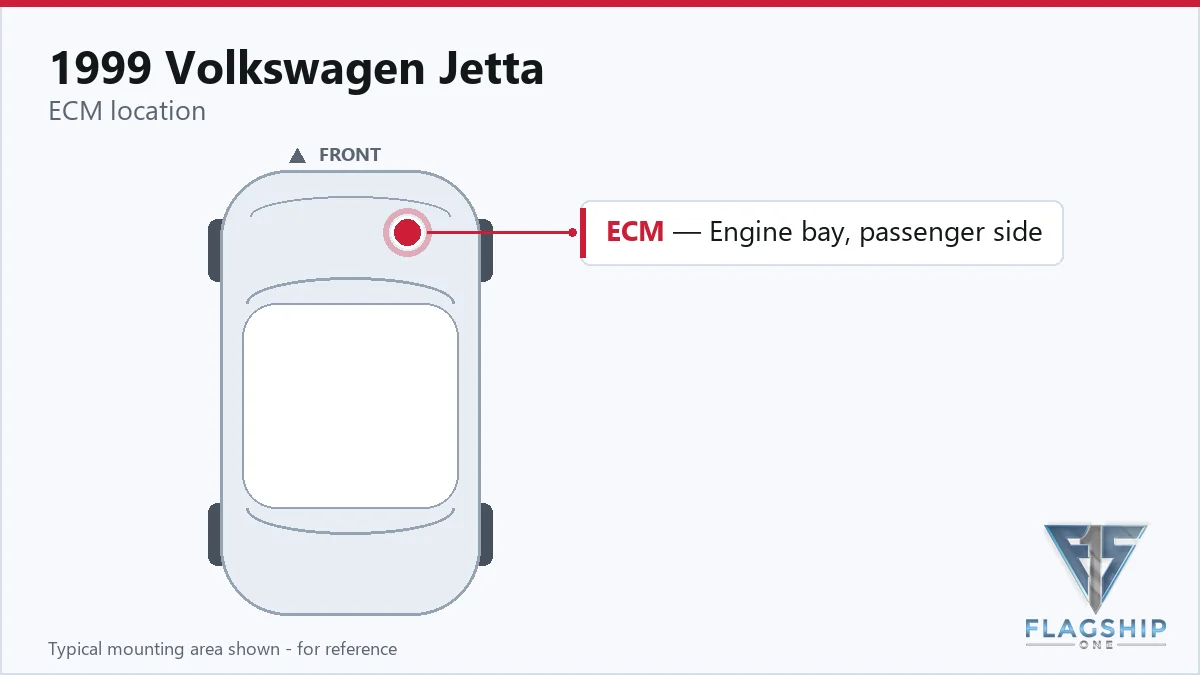
The factory component-location overview places the engine control module in the plenum chamber on the right side. Accessing the unit requires working in this under-hood area, which may involve moving aside related components like the evaporative emission canister plumbing or intake parts. When replacing the unit, the specified book time for removal and installation on the 1.9L engine is 0.6 hours. If you own a different engine variant, the labor times vary, with 1.1 hours allocated for the 2.0L and 2.8L versions. Once the new computer is physically installed, the powertrain control module relearn procedure requires 0.5 hours, while an engine control module reset adds 0.3 hours, and a separate engine control module relearn takes 0.5 hours. These times reflect the standard manual processes for clearing adaptive memory and establishing new baseline values.
| Operation | Configuration | Book Time |
|---|---|---|
| Powertrain Control Module Relearn | All configurations | 0.5 hr |
| Powertrain Control Module R&R | All configurations | 0.3 hr |
| Engine Control Module R&R | 2.0L | 1.1 hr |
| Engine Control Module R&R | 2.8L | 1.1 hr |
| Engine Control Module R&R | 1.9L | 0.6 hr |
| Engine Control Module Reset | All configurations | 0.3 hr |
| Engine Control Module Relearn | All configurations | 0.5 hr |
Following a module swap, the factory procedure requires specific programming steps to ensure the computer communicates properly with the vehicle. The standard workflow involves an engine control module reset, which takes 0.3 hours, followed by an engine control module relearn period of 0.5 hours. Additionally, a powertrain control module relearn may be necessary, adding another 0.5 hours to the diagnostic process. These procedures typically demand specialized diagnostic equipment to match the unit to your immobilizer and sync the throttle body. Skipping these steps often leaves the vehicle undrivable. However, choosing pre-programmed Jetta computers bypasses this lengthy dealership routine. Because these units arrive already configured to your vehicle identification number, the complex relearn and reset phases are already completed, allowing for a straightforward plug-and-play installation.
When the engine computer begins to fail in the 1999 Volkswagen Jetta, several noticeable drivability symptoms often arise. The vehicle may experience unexpected stalling at idle or refuse to start altogether. Misfire codes frequently appear, alongside erratic shifting or poor fuel economy. Communication issues with diagnostic scan tools are also a common indicator of internal processor failure. As the unit loses its ability to process sensor data, the check engine light will typically illuminate. In many cases, scanning the system reveals internal fault codes such as P0605, indicating internal ROM faults that directly point to computer degradation rather than a simple sensor issue. Addressing these symptoms quickly prevents the vehicle from leaving you stranded and avoids cascading damage to other engine management components.
Specific diagnostic trouble codes can confirm internal failures within the engine management system. The following module-internal fault codes are documented for the 1999 Volkswagen Jetta, typically indicating that the computer itself requires replacement rather than a related sensor or wiring repair.
| Code | Meaning | Full Guide |
|---|---|---|
| P0604 | Internal RAM error | Full P0604 guide → |
| P0605 | Internal ROM error | Full P0605 guide → |
| P0606 | Module processor failure | Full P0606 guide → |
Volkswagen issued technical service bulletins regarding computer issues for this model. Bulletin 01-07-09 addresses situations where the driver reports the malfunction indicator lamp turning on, and diagnostic code 00281 registers within the transmission control module memory. This often indicates a communication discrepancy between modules rather than a simple sensor failure. Separately, bulletin 24-07-102 covers 1999 models across all engine codes except the 2.0L AEG variant, detailing the proper procedure for engine control module replacement. Reviewing these bulletins is highly recommended before purchasing parts, as they provide essential factory guidance for diagnosing whether a new module is required or if the issue stems from related wiring or sensor problems.
| Bulletin | Subject | What It Addresses |
|---|---|---|
| 01-07-09 | 01-07-09 – Customer States MIL ON, DTC 00281 Stored in TCM DTC Memory | — |
| 24-07-102 | TT 24-07-102 1999 > All Vehicles, All Engine Codes except 2.0L AEG – ECM Replacement | — |
It operates the fuel injection system and manages oxygen sensor control, alongside evaporative emission functions, to ensure the motor runs efficiently.
The factory places the unit inside the right side of the plenum chamber, which is under the hood near the windshield.
The specified book time for removal and installation on the 1.9L engine is 0.6 hours, though additional time is necessary for relearn procedures.
Deciding between repairing a failing computer or opting for a refurbished replacement depends on the severity of the internal damage. For the 1999 Volkswagen Jetta, internal memory faults rarely respond reliably to simple repairs. Choosing a pre-programmed replacement unit often provides a more dependable long-term solution, restoring proper fuel and emission controls without the uncertainty of component-level soldering. This route quickly gets your vehicle back on the road.
Flagship One stocks a refurbished, VIN-programmed PCM for the 1999 Volkswagen Jetta with a lifetime warranty, free shipping and no core charge. The full Volkswagen Jetta module lineup covers other engine configurations as well.
Addressing engine computer issues in your 1999 Volkswagen Jetta requires accurate diagnostics and careful replacement. Understanding the location, programming requirements, and related service bulletins ensures a smooth repair process. When internal faults appear, replacing the unit with a properly programmed module eliminates the hassle of dealership visits. Trust Flagship One to provide the exact replacement your vehicle requires to run efficiently again.