
Last updated on August 25th, 2026 at 12:18 pm
The engine control module (ECM) in the 1999 Audi A4 1.8L manages fuel injection, ignition timing, and emissions systems. Failure may cause erratic engine behavior, no-start conditions, or persistent check-engine lights with sensor-related trouble codes.
If your 1999 Audi A4 1.8L suddenly refuses to start, stalls unexpectedly, or throws cryptic engine codes, the engine control module may be the culprit. This compact computer sits at the heart of your vehicle’s powertrain, translating sensor data into precise fuel and ignition commands. When it fails, symptoms can range from subtle drivability quirks to complete immobilization. Replacing it isn’t just about swapping hardware—it involves careful access, proper installation, and a mandatory relearn procedure to ensure the new module syncs with your engine’s unique characteristics. Understanding these steps helps you anticipate repair costs, avoid unnecessary dealer visits, and restore reliable operation. Whether you’re a DIY enthusiast or working with a shop, knowing what to expect demystifies the process and prevents surprises during the repair.
The engine control module in your 1999 Audi A4 1.8L serves as the brain of the engine management system, continuously monitoring inputs from sensors like the mass airflow meter, oxygen sensors, and throttle position sensor. It uses this data to calculate the optimal air-fuel mixture, ignition timing, and idle speed for every driving condition. This ensures efficient combustion, smooth acceleration, and compliance with emissions standards. When the module malfunctions, your vehicle may experience poor fuel economy, rough idling, or even fail to start. Because it integrates with the auxiliary relay and fuse panel, its location and electrical connections are critical during replacement. If you need a new unit, replacement engine control modules for the Audi A4 are designed to match the original specifications, but proper installation and programming are essential to avoid drivability issues.
1999 Audi A4 1.8L:
OEM programmed replacements — plug & play, no dealer visit.
Find yours by year, make & model →
Free shipping · Lifetime warranty
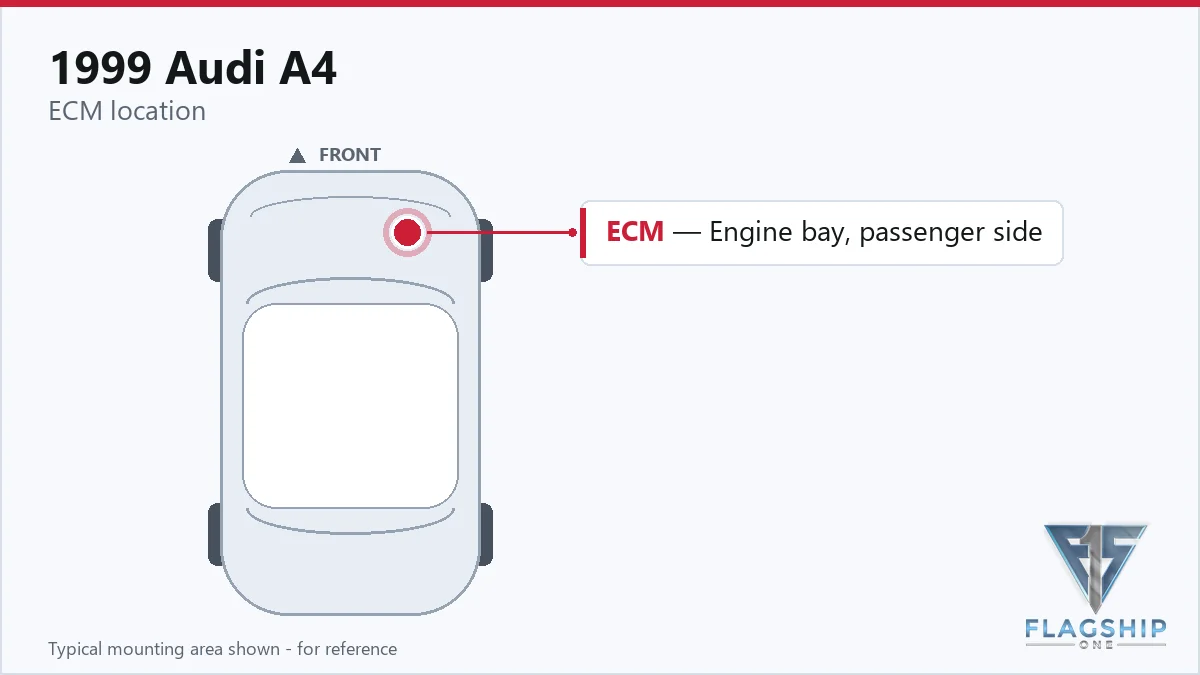
In the 1999 Audi A4 1.8L, the engine control module is housed within the plenum chamber, specifically in the area labeled ‘Operating Electronics.’ It’s integrated with the auxiliary relay panel and auxiliary fuse panel, which means accessing it requires removing the plenum cover and carefully disconnecting adjacent components. The factory service manual specifies a labor time of 0.5 hours for removal and reinstallation, whether your vehicle is a front-wheel-drive model or a Quattro. This time estimate assumes the technician has clear access and doesn’t encounter corroded connectors or seized fasteners. Once the old module is removed, the new unit must be seated securely, and all electrical connections should be inspected for damage or contamination before reassembly. No special torque specifications are provided, but connectors should be firmly seated to prevent intermittent electrical issues.
| Operation | Configuration | Book Time |
|---|---|---|
| Engine Control Module Relearn | A4 | 0.5 hr |
| Engine Control Module Relearn | A4 Quattro | 0.5 hr |
| Engine Control Module R&R | A4 | 0.5 hr |
| Engine Control Module R&R | A4 Quattro | 0.5 hr |
| Powertrain Control Module R&R | A4 | 0.5 hr |
| Powertrain Control Module R&R | A4 Quattro | 0.5 hr |
| Powertrain Control Module Relearn | A4 | 0.5 hr |
| Powertrain Control Module Relearn | A4 Quattro | 0.5 hr |
After installing a new engine control module in your 1999 Audi A4 1.8L, the factory procedure requires a relearn process to synchronize the module with the engine’s sensors and adaptive fuel strategies. This typically involves using a diagnostic scan tool to reset learned values and may include a drive cycle to allow the module to recalibrate. The labor time for this relearn is also 0.5 hours, whether your vehicle is a standard A4 or a Quattro. However, if you opt for a VIN-programmed replacement unit, these steps are already completed before the module arrives. This eliminates the need for post-installation dealer programming, saving time and reducing the risk of incomplete synchronization, which can lead to poor drivability or persistent check-engine lights.
A failing engine control module in the 1999 Audi A4 1.8L often announces itself through a variety of symptoms, some subtle and others impossible to ignore. You may notice the engine stalling at idle or during deceleration, particularly after a cold start. Hesitation or surging under acceleration is another common sign, as the module struggles to maintain the correct air-fuel ratio. The check-engine light may illuminate, often accompanied by trouble codes related to sensor performance or fuel trim. One frequent code is internal control module memory checksum error, which indicates the module’s memory has been corrupted or is failing. In some cases, the vehicle may fail to start altogether, with no spark or fuel delivery, despite a functional starter and battery. Scan tool communication issues, such as the inability to connect to the ECM, can also point to module failure. Less obvious symptoms include poor fuel economy, rough idling, or even transmission shifting irregularities, as the ECM communicates with the transmission control module to optimize gear changes. If you experience any of these issues, it’s worth having the module tested before assuming a more expensive sensor or mechanical failure.
Driving with a failing ECM is risky. While the vehicle may run intermittently, symptoms like stalling, misfires, or sudden power loss can occur without warning. This not only leaves you stranded but may also cause additional damage to sensors or the catalytic converter. If you suspect ECM failure, it’s best to address it promptly.
Distinguishing between ECM failure and a faulty sensor can be challenging. Start by scanning for trouble codes—if multiple unrelated codes appear (e.g., oxygen sensor and throttle position sensor), the ECM may be the culprit. A professional can perform resistance and voltage tests on sensors to rule them out before condemning the module.
In this vehicle, the terms ECM (engine control module) and PCM (powertrain control module) are often used interchangeably, as the module handles both engine and transmission functions. The labor times for replacement and relearn are identical for both, and the physical location remains the same.
Skipping the relearn procedure may result in poor drivability, including rough idling, hesitation, or even a no-start condition. The new module won’t adapt to your engine’s unique characteristics, leading to incorrect fuel trim or ignition timing. This can also trigger persistent check-engine lights or sensor-related codes.
Yes, a weak or failing battery can cause voltage fluctuations that stress the ECM. Low voltage may prevent the module from powering up correctly, while voltage spikes during jump-starts or charging can damage its circuits. Always ensure your battery and charging system are in good condition to protect the ECM.
If your 1999 Audi A4 1.8L is exhibiting signs of ECM failure, you have two primary repair paths: a costly dealer replacement with on-site programming or a more affordable refurbished unit. Refurbished modules are often pre-programmed to your vehicle’s VIN, eliminating the need for a dealer relearn and reducing downtime. Given the labor time of just 0.5 hours for installation, this option can be both time-efficient and budget-friendly, especially if you’re working with an independent shop or tackling the job yourself.
Flagship One stocks a refurbished, VIN-programmed PCM for the 1999 Audi A4 with a lifetime warranty, free shipping and no core charge. The full Audi A4 module lineup covers other engine configurations as well.
The engine control module in your 1999 Audi A4 1.8L plays a critical role in keeping your vehicle running smoothly. When it fails, symptoms like stalling, misfires, or a no-start condition can disrupt your daily routine. Understanding the module’s location, replacement process, and programming requirements helps you make informed decisions about repairs. Whether you choose a dealer-installed unit or a pre-programmed replacement, addressing ECM issues promptly ensures reliable performance and avoids more costly damage down the road.