
Last updated on August 25th, 2026 at 01:01 pm
The Engine Control Module (ECM) in your 1997 Audi Cabriolet manages fuel injection, ignition timing, and emissions systems. Failure may cause erratic engine behavior, stalling, or a complete no-start condition, often triggered by voltage spikes or corrosion.
If your 1997 Audi Cabriolet has been stalling unexpectedly, refusing to start, or throwing cryptic engine codes, the Engine Control Module (ECM) may be the culprit. This small but critical computer manages everything from fuel delivery to ignition timing, and when it fails, your vehicle’s performance suffers. Replacing it isn’t just about swapping a part—it involves precise labor, location challenges, and a mandatory relearn procedure to restore proper function. Understanding these steps helps you avoid unnecessary dealer trips or incomplete repairs. Whether you’re a DIY enthusiast or working with a shop, knowing what to expect with labor times, module location, and post-install requirements ensures a smoother process. A pre-programmed replacement unit can save you time and hassle, letting you focus on getting your Cabriolet back on the road reliably.
1997 Audi Cabriolet
OEM programmed ECM for your 1997 Audi Cabriolet — plug & play, no dealer visit.
Free shipping · Lifetime warranty
The Engine Control Module in your 1997 Audi Cabriolet serves as the brain of the engine management system, coordinating fuel injection, ignition timing, and emissions controls. Without it, the 2.8L V6 engine cannot operate efficiently—or at all. This module constantly adjusts parameters based on sensor inputs, ensuring optimal performance and fuel economy. When it fails, you may notice symptoms like rough idling, hesitation under acceleration, or even a complete loss of power. Replacing it requires careful handling, as the module’s replacement engine computers for the Cabriolet must match the vehicle’s original specifications to avoid compatibility issues. Its role is so central that even minor glitches can trigger a cascade of engine problems, making timely replacement essential for reliable operation.
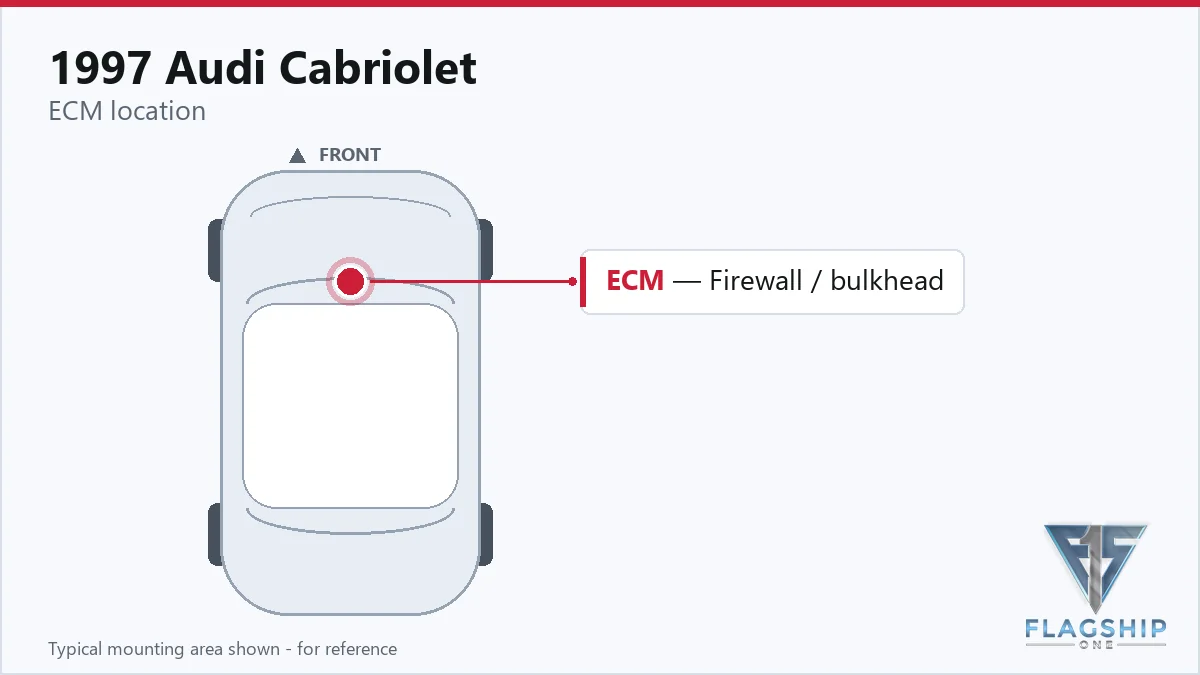
The ECM in your 1997 Audi Cabriolet is tucked above the right-front footwell, sandwiched between the evaporator housing and the bulkhead. Accessing it requires removing interior trim panels and possibly disconnecting climate control components, depending on the vehicle’s configuration. The factory labor time for removal and reinstallation is 1.1 hours, reflecting the tight quarters and careful handling needed to avoid damaging adjacent parts. Once exposed, the module is secured with fasteners, and its electrical connector must be released before extraction. Reinstallation follows the reverse process, ensuring all connections are clean and properly seated. No specialized tools are required beyond basic hand tools, but patience is key due to the confined workspace.
| Operation | Configuration | Book Time |
|---|---|---|
| Engine Control Module Relearn | All configurations | 0.5 hr |
| Engine Control Module R&R | All configurations | 1.1 hr |
| Powertrain Control Module R&R | All configurations | 1.1 hr |
| Powertrain Control Module Relearn | All configurations | 0.5 hr |
After replacing the ECM in your 1997 Audi Cabriolet, the factory procedure mandates a 0.5-hour relearn process to synchronize the module with the vehicle’s sensors and systems. This step is critical for restoring proper engine performance, fuel efficiency, and emissions compliance. However, if you install a VIN-programmed replacement unit, these relearn steps are already completed, saving you time and potential dealer fees. The pre-programmed module arrives configured to your vehicle’s specifications, eliminating the need for additional setup. This not only simplifies the installation but also reduces the risk of post-install issues like stalling or poor drivability, which can occur if the relearn procedure is skipped or performed incorrectly.
A failing ECM in your 1997 Audi Cabriolet often announces itself through a range of frustrating symptoms. You might experience intermittent stalling, especially at idle or during deceleration, or the engine may refuse to start altogether. Misfires are another common sign, often accompanied by a rough or uneven idle, as the module struggles to maintain proper ignition timing. Some drivers report hesitation or surging under acceleration, while others notice the check engine light illuminating with codes related to fuel or ignition system faults. In severe cases, the vehicle may enter a limp-home mode, drastically reducing power to prevent further damage. Communication issues with scan tools are also a red flag, as the ECM may fail to respond or provide incomplete data. One specific code, internal control module memory checksum error, often appears when the module’s memory integrity is compromised, signaling the need for replacement.
Random stalling, particularly after the vehicle has been parked, often points to an ECM struggling with memory retention or sensor synchronization. Voltage drops during startup can exacerbate these issues, making the module fail to maintain stable engine operation. Replacing the ECM with a pre-programmed unit may resolve the problem by restoring proper communication with the engine’s sensors.
While the vehicle may still run with a P0601 code, it’s not advisable to ignore it. This code indicates an internal memory fault in the ECM, which can lead to unpredictable engine behavior, including stalling or misfires. Driving with this issue may cause further damage to the engine management system or leave you stranded. Addressing it promptly ensures reliable operation.
ECM failures often present as multiple, seemingly unrelated symptoms, such as stalling, misfires, and communication errors with scan tools. If you’ve ruled out common sensor issues (like a faulty crankshaft or camshaft sensor) and the symptoms persist, the ECM may be the culprit. A professional diagnostic scan can help confirm whether the module is at fault.
Testing the ECM typically involves checking for proper voltage at the connectors, verifying communication with a scan tool, and inspecting for physical damage or corrosion. However, internal faults like memory corruption or processor failure may not be detectable without specialized equipment. If all other components check out and symptoms persist, replacement is often the most reliable solution.
Skipping the relearn procedure can result in poor engine performance, including rough idling, hesitation, or even stalling. The ECM needs to synchronize with the vehicle’s sensors and systems to operate correctly. Without this step, the module may not adjust fuel delivery or ignition timing properly, leading to drivability issues. Using a pre-programmed unit eliminates this risk by ensuring the module is ready to go out of the box.
When your 1997 Audi Cabriolet’s ECM fails, you have two main options: repair or replace. Repairing the module may be cost-effective for minor issues, but it often doesn’t address underlying faults like memory corruption or internal component failure. A replacement unit, particularly one that’s pre-programmed to your vehicle’s VIN, offers a more reliable solution. This approach eliminates the need for dealer reprogramming and ensures compatibility with your Cabriolet’s engine management system, saving you time and potential headaches.
Flagship One stocks a refurbished, VIN-programmed PCM for the 1997 Audi Cabriolet with a lifetime warranty, free shipping and no core charge. The full Audi Cabriolet module lineup covers other engine configurations as well.
Replacing the ECM in your 1997 Audi Cabriolet is a straightforward process when you understand the labor involved, module location, and post-install requirements. Whether you’re dealing with stalling, misfires, or a no-start condition, a pre-programmed replacement unit can restore your vehicle’s performance without the hassle of additional dealer setup. Addressing ECM issues promptly ensures your Cabriolet remains reliable and enjoyable to drive for years to come.