
Last updated on August 25th, 2026 at 12:07 pm
The engine control module (ECM) in the 1993 Saab 9000 2.3L manages fuel injection, ignition timing, and idle speed. Failure often results from capacitor leakage, solder joint cracks, or voltage spikes, leading to no-start, stalling, or erratic performance.
If your 1993 Saab 9000 with the 2.3L engine has started acting up—maybe it cranks but won’t fire, stalls unpredictably, or runs rough—the engine control module (ECM) could be the culprit. This electronic brain manages fuel delivery, ignition timing, and idle control, and when it fails, the car may become undrivable. Because this vehicle is pre-OBD-II, it does not use standard diagnostic trouble codes; instead, it relies on a flash-code system that blinks the check engine light to indicate faults. Understanding how the ECM works, where it lives, and what replacement involves can save you time and frustration. This article covers the common failure symptoms, the module’s location behind the glove box and kick panel, and what to expect when replacing it. You will also learn why a pre-programmed replacement unit simplifies the job and gets your Saab back on the road reliably.
The engine control module in your 1993 Saab 9000 2.3L is a sealed electronic unit that acts as the central processor for the engine management system. It receives input from sensors such as the crankshaft position sensor, throttle position sensor, coolant temperature sensor, and oxygen sensor. Based on that data, it calculates the correct fuel injector pulse width, ignition timing advance, and idle air control valve position. It also controls the fuel pump relay and the check engine light. In this specific vehicle, the ECM is a Bosch unit that is known for developing cold solder joints and leaking electrolytic capacitors over time, especially in the capacitors that filter the internal power supply. When those capacitors fail, the module may lose its programming or produce erratic outputs. That is why many owners turn to replacement ECMs for the Saab 9000 when the original unit becomes unreliable. The ECM does not communicate with a generic OBD-II scanner; instead, you must use a Saab-specific diagnostic tool or read flash codes from the check engine light. Because the module controls so many critical functions, a failure can leave you stranded. Recognizing the signs early and addressing them with a quality replacement is the most effective way to restore proper operation.
1993 Saab 9000 2.3L
OEM programmed ECM for your 1993 Saab 9000 2.3L — plug & play, no dealer visit.
Free shipping · Lifetime warranty
The ECM in the 1993 Saab 9000 2.3L is mounted in two possible locations depending on the production date and trim: behind the glove box or behind the kick panel on the passenger side. The factory removal procedure involves accessing the module from either of these positions. To reach it behind the glove box, you must first empty and remove the glove box liner, which typically involves releasing a few clips or screws. The module is then visible, secured by a bracket and connected to a large wiring harness. If the module is behind the kick panel, you will need to remove the plastic trim panel on the passenger side footwell. In both cases, disconnect the battery negative terminal before unplugging any connectors to avoid short circuits. The module is held in place by a few bolts or screws. Replacement involves transferring the mounting bracket to the new unit if needed, then plugging in the harness and securing the module. No special tools are required beyond basic hand tools. The entire job can typically be completed in under an hour, though access may be tight in some configurations.
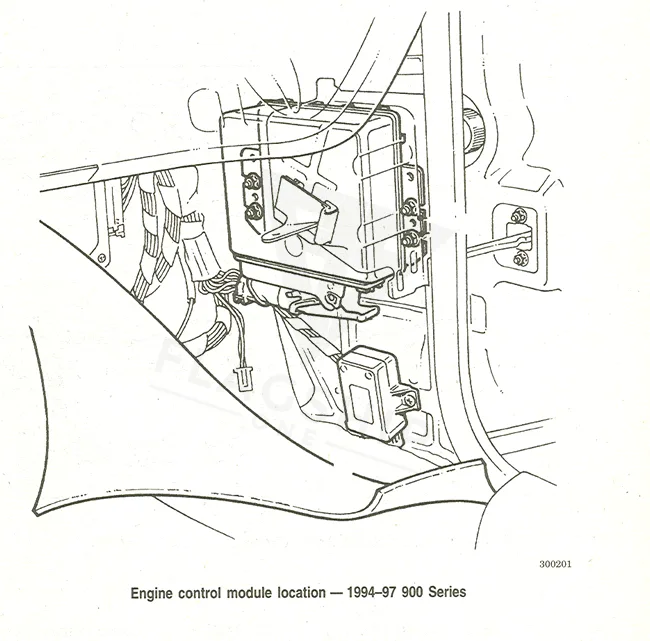
Work with the ignition off, and treat the module as static-sensitive: avoid touching the connector pins at any point.
After installing a replacement ECM in your 1993 Saab 9000 2.3L, the factory procedure requires that the module be programmed with the vehicle’s VIN and any immobilizer or anti-theft data. This step is essential because the ECM must recognize the car’s specific configuration to control the engine correctly. Without proper programming, the module may not start the engine or may run poorly. The programming process typically involves a dealer-level diagnostic tool that can communicate with the pre-OBD-II system. However, when you purchase a VIN-programmed replacement unit from Flagship One, that step is already completed. The module arrives ready to install, with your vehicle’s VIN and calibration data loaded. This eliminates the need for a trip to the dealer or a specialized shop. Simply install the unit, reconnect the battery, and start the engine. In most cases, the car will run immediately, though you may need to perform a brief idle relearn procedure if the idle is unstable. The pre-programmed unit ensures a straightforward swap without additional programming costs or delays.
When the ECM in your 1993 Saab 9000 2.3L begins to fail, you may notice a range of symptoms that can be intermittent at first. The most common complaint is a no-start condition where the engine cranks but does not fire. This happens because the ECM is not sending the correct fuel injector or ignition signals. Another frequent symptom is stalling, often occurring when the engine is warm or under load. The car may also hesitate or surge during acceleration, or idle roughly. Because the ECM controls the idle air control valve, a failing module can cause the idle to hunt or stall when coming to a stop. You might also see the check engine light illuminate with a flash code pattern that does not match any known fault. In some cases, the engine may run but with reduced power or poor fuel economy. Since this is a pre-OBD-II system, you will not see generic P-codes; instead, you must read the flash codes by grounding a diagnostic pin or using a Saab-specific tool. If the ECM has internal capacitor leakage, you may also notice a burnt electronic smell or visible corrosion on the module’s circuit board. Addressing these symptoms promptly can prevent being stranded.
You can read flash codes by grounding the diagnostic pin under the dashboard and counting the check engine light blinks. However, this only indicates stored faults, not whether the ECM itself is functional. A known-good swap is often the most reliable test.
A used ECM may work if it comes from the same model year and engine, but it will need to be programmed with your vehicle’s VIN. Without programming, it may not start or may run poorly. A pre-programmed unit is a more dependable option.
The most common cause is internal capacitor leakage or failure, which can corrode the circuit board. Voltage spikes from a bad alternator or jump-starting, as well as moisture intrusion through the connector, are also frequent contributors.
Yes, the replacement is straightforward if you are comfortable removing the glove box or kick panel trim. Disconnect the battery, unplug the old module, install the new one, and reconnect. No special tools are required.
If the replacement unit is pre-programmed, you may only need to perform an idle relearn by letting the engine idle for a few minutes. No additional reset is required. If the unit is not pre-programmed, a dealer visit is necessary.
When your 1993 Saab 9000 2.3L ECM fails, you have two main options: repair the original module or replace it with a refurbished unit. Repairing a leaking capacitor or cracked solder joint can be cost-effective, but the module may fail again. A refurbished replacement from Flagship One offers a reliable, pre-programmed solution that eliminates the need for dealer programming and gets your Saab back on the road quickly.
Flagship One stocks a refurbished, VIN-programmed ECM for the 1993 Saab 9000 with a lifetime warranty, free shipping and no core charge. The full Saab 9000 module lineup covers other engine configurations as well.
The engine control module in your 1993 Saab 9000 2.3L is a critical component that can cause frustrating driveability issues when it fails. Understanding its location behind the glove box or kick panel, recognizing symptoms like no-start and stalling, and knowing that a pre-programmed replacement simplifies the job will help you make an informed repair decision. Keep your Saab running reliably with a quality ECM replacement.