
Last updated on August 25th, 2026 at 01:29 pm
The Powertrain Control Module (PCM) in your 1992 GMC Typhoon manages fuel delivery, ignition timing, and transmission shifts. Failure may cause hard starts, stalling, or poor drivability, often mimicking fuel or ignition system issues.
If your 1992 GMC Typhoon has been acting up—stalling at stops, refusing to start, or running roughly—you might be dealing with a failing Powertrain Control Module (PCM). This small but critical computer oversees everything from fuel injection to transmission shifts, and when it malfunctions, symptoms can be frustratingly inconsistent. Unlike mechanical issues, PCM problems often don’t leave obvious physical clues, making diagnosis tricky without the right knowledge. Understanding where the module is located, how to replace it safely, and what signs point to failure can save you time and guesswork. Whether you’re troubleshooting a no-start condition or preparing for a replacement, knowing the specifics of your Typhoon’s PCM will help you approach the repair with confidence.
1992 GMC Typhoon
OEM programmed ECM for your 1992 GMC Typhoon — plug & play, no dealer visit.
Free shipping · Lifetime warranty
The Powertrain Control Module (PCM) in your 1992 GMC Typhoon acts as the brain of the engine and transmission, coordinating fuel delivery, ignition timing, and shift points to keep the vehicle running smoothly. Without it, the engine may fail to start, run erratically, or even stall unexpectedly. Because the Typhoon relies on this single module for both engine and transmission control, a malfunction can affect multiple systems at once. When shopping for a replacement, you’ll want to focus on replacement PCMs for the GMC Typhoon, ensuring compatibility with your vehicle’s specific configuration. A properly functioning PCM ensures optimal performance, fuel efficiency, and drivability, making it one of the most important components under the hood.
In the 1992 GMC Typhoon, the PCM is most commonly found inside the passenger compartment, mounted on the right side near the dashboard. Some later models with the VCM-A variant may have the module located in the engine bay, secured to the right fender or wheel well area. Replacing the PCM involves disconnecting the negative battery cable first—always with the ignition off—to prevent electrical damage. After locating the module, you’ll unplug the wiring harness and remove any mounting bolts or brackets. Installation follows the reverse order, ensuring the new module is securely fastened and all connectors are fully seated. While the physical replacement is straightforward, proper handling is critical to avoid static discharge or voltage spikes that could harm the new unit.
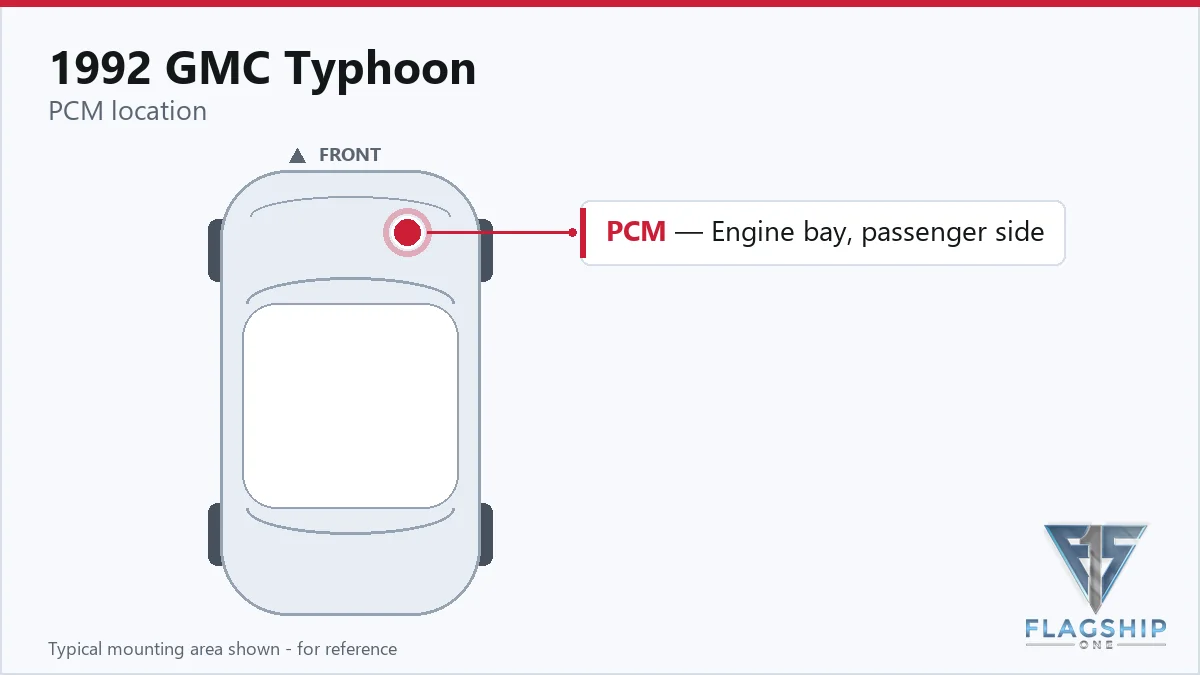
Work with the ignition off, and treat the module as static-sensitive: avoid touching the connector pins at any point.
After installing a new PCM in your 1992 GMC Typhoon, the factory procedure typically requires a programming step to sync the module with your vehicle’s VIN and specific calibration settings. This ensures the engine and transmission operate correctly for your Typhoon’s unique configuration. However, when you opt for a VIN-programmed replacement unit, these steps are already completed, saving you the hassle of additional programming. This means you can install the module and drive the vehicle without needing specialized tools or dealer visits. The pre-programmed unit arrives ready to plug in, reducing downtime and potential errors during the process.
A failing PCM in your 1992 GMC Typhoon may produce a range of symptoms that can be easy to mistake for other issues. Common signs include intermittent stalling, especially at idle or during deceleration, as well as hard starting or a complete no-crank condition. You might also notice erratic shifting if the transmission isn’t receiving proper signals, or the engine may misfire under load. Another telltale sign is a lack of communication with a scan tool, which can leave you without diagnostic trouble codes to guide the repair. In some cases, the vehicle may run fine one day and refuse to start the next, making the problem seem random. If you’ve ruled out fuel, ignition, and battery issues, the PCM could be the culprit, particularly if symptoms align with internal faults like memory integrity error. Addressing these symptoms early can prevent further drivability issues and potential breakdowns.
Stalling at idle while running normally at higher speeds often points to a PCM issue, particularly if the module isn’t correctly managing fuel or ignition timing. The Typhoon’s PCM relies on input from multiple sensors, and if it misinterprets these signals, it may cut fuel or spark at low RPMs. Other possibilities include vacuum leaks or a failing idle air control valve, but if those check out, the PCM should be tested.
Yes, the PCM in your 1992 GMC Typhoon controls both engine and transmission functions, so a failing module can lead to erratic or harsh shifts. The PCM determines shift points based on sensor inputs, and if it’s not processing these signals correctly, the transmission may shift too early or too late. Before assuming a mechanical transmission issue, have the PCM scanned for faults or consider a replacement if symptoms persist.
Distinguishing between a bad PCM and a wiring issue can be challenging, but there are a few clues. Start by checking for power and ground at the PCM connector—if either is missing, the problem likely lies in the wiring or fuse. If power and ground are present but the PCM still doesn’t communicate with a scan tool, the module itself may be faulty. Visual inspection of the wiring harness for damage or corrosion can also help rule out wiring issues before condemning the PCM.
A no-start condition in your 1992 GMC Typhoon can stem from several causes, including a faulty PCM, but it’s not always the first thing to check. Start by verifying fuel pressure, spark, and compression, as these are more common culprits. If those systems are functioning but the engine still won’t start, the PCM may not be sending the correct signals to the fuel injectors or ignition system. In that case, a replacement PCM could resolve the issue, especially if the original module shows signs of internal failure.
Driving with a suspected bad PCM can be risky, as the module controls critical engine and transmission functions. If the PCM is intermittently failing, you may experience sudden stalling, loss of power, or erratic shifting, which could lead to unsafe driving conditions. If you notice symptoms like hard starting, misfires, or transmission issues, it’s best to address the problem promptly to avoid potential breakdowns or further damage to the vehicle.
If your 1992 GMC Typhoon is showing signs of PCM failure, you have a few options for moving forward. A repair shop can diagnose the issue, but if the module is confirmed faulty, replacement is often the most reliable solution. Refurbished units designed specifically for the Typhoon can restore full functionality without the cost of a new OEM part. With a VIN-programmed replacement, you’ll avoid the hassle of additional programming, allowing you to get back on the road quickly and confidently.
Flagship One stocks a refurbished, VIN-programmed ECM for the 1992 GMC Typhoon with a lifetime warranty, free shipping and no core charge. The full GMC Typhoon module lineup covers other engine configurations as well.
The 1992 GMC Typhoon relies on its PCM to keep the engine and transmission running smoothly, and when it fails, symptoms can range from subtle drivability issues to complete no-start conditions. Knowing where the module is located, how to replace it safely, and what signs to watch for can help you address problems before they leave you stranded. Whether you’re troubleshooting a stalling issue or preparing for a replacement, understanding your Typhoon’s PCM ensures you’re equipped to handle the repair effectively.