
Last updated on August 25th, 2026 at 01:25 pm
The engine control module (ECM) in the 1990 Geo Tracker 1.6L is the primary computer that manages fuel delivery, ignition timing, and idle speed. When it fails, the engine may crank without starting, stall unexpectedly, or run with noticeable hesitation and poor fuel economy.
When a 1990 Geo Tracker with the 1.6L engine develops hard-start or stalling issues that defy basic fuel and spark checks, the engine control module (ECM) often becomes the prime suspect. This compact SUV, built during an era of simpler electronics, relies on a single computer to interpret sensor signals and command the fuel injectors and ignition system. Unlike modern vehicles that store dozens of diagnostic trouble codes, the Tracker’s ECM offers only limited self-diagnostics, making symptom recognition critical. You may notice the engine cranks but refuses to fire, or it starts and then dies without warning. Sometimes the idle becomes erratic or the engine hesitates under load. These behaviors can mimic fuel pump or ignition module failures, leading to unnecessary parts swapping. Understanding how the ECM functions, where it is located, and what a proper replacement entails will help you avoid misdiagnosis and get your Tracker back on the road. This guide explains the module’s role, walks through the removal and installation process, and clarifies why a pre-programmed replacement unit can save hours of frustration. You will also find practical tips to protect the new ECM and ensure long-term reliability.
1990 Geo Tracker 1.6L
OEM programmed ECM for your 1990 Geo Tracker 1.6L — plug & play, no dealer visit.
Free shipping · Lifetime warranty
The engine control module in the 1990 Geo Tracker 1.6L acts as the brain of the fuel and ignition systems. It receives input from sensors such as the throttle position sensor, coolant temperature sensor, oxygen sensor, and manifold absolute pressure sensor, then calculates the precise amount of fuel to deliver and the optimal spark timing. The ECM also controls the idle air control valve to maintain a steady idle speed under varying loads. Because the Tracker’s 1.6L engine uses a distributor-based ignition and a relatively simple fuel injection setup, the module’s programming is tailored specifically to this powertrain. When the ECM begins to fail, the engine may exhibit hard starting, sudden stalling, or a no-start condition where the fuel pump does not prime and the injectors do not fire. Unlike later OBD-II systems, this ECM does not store standardized diagnostic trouble codes that can be read with a generic scan tool; instead, it may flash a limited set of codes through the check engine light when placed in diagnostic mode. A faulty ECM can also cause the engine to run rich or lean, leading to poor fuel economy and potential catalytic converter damage. For owners seeking replacement ECMs for the Tracker, it is essential to match the exact calibration code and transmission type, as the module’s programming differs between manual and automatic applications. A properly functioning ECM restores crisp throttle response, stable idle, and reliable hot and cold starts, making it a cornerstone of the Tracker’s drivability.
The factory service procedure for the 1990 Geo Tracker places the engine control module behind the glove box and on the firewall. To reach it, you must first open the glove box, release the stop tabs, and swing the door fully down to access the mounting area. The ECM is secured to a bracket on the firewall with two or three fasteners. After disconnecting the negative battery cable, you can unplug the main harness connector by pressing the locking tab and gently rocking the connector free. The module then slides out of the bracket. Installation follows the reverse order, but it is critical to ensure the connector is fully seated and the locking tab engages to prevent intermittent contact. Because the module is located inside the passenger compartment, it is protected from direct moisture and road debris, yet it can still suffer from heat buildup if the heater core or blower motor is nearby. When reinstalling, take care not to pinch the wiring harness between the bracket and the firewall, as this can cause chafing and short circuits over time.
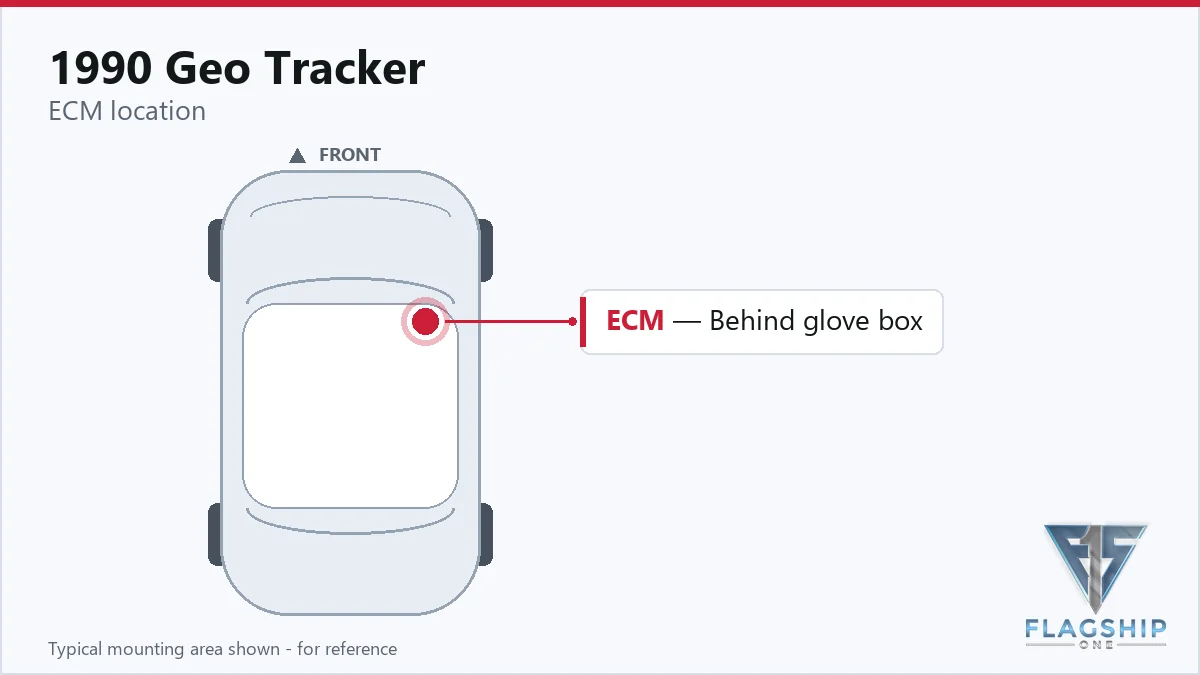
Work with the ignition off, and treat the module as static-sensitive: avoid touching the connector pins at any point.
On the 1990 Geo Tracker, a factory-fresh ECM requires transferring the original PROM (programmable read-only memory) chip from the old module to the new one, or manually setting the base idle speed and ignition timing after installation. The PROM chip contains the vehicle-specific calibration data, and without it the engine will not run correctly. This delicate procedure involves removing a small access cover, carefully prying out the chip, and aligning it in the new module’s socket—a task that can damage pins if not done properly. Alternatively, some replacement modules must be programmed with a manufacturer-specific tool that many independent shops do not possess. Choosing a pre-programmed replacement ECM eliminates these steps entirely. Flagship One units arrive with your Tracker’s VIN and calibration already loaded, so you simply install the module and turn the key. The engine should start and idle normally without any additional chip transfer or dealer programming. This plug-and-play approach saves time and reduces the risk of damaging sensitive electronics during the swap.
A failing ECM in the 1990 Geo Tracker often produces symptoms that can be mistaken for fuel or ignition problems. The most common complaint is a no-start condition where the engine cranks strongly but does not fire. This happens because the ECM fails to ground the fuel pump relay or trigger the injectors. In other cases, the engine may start and run briefly before stalling, especially when the module warms up and internal solder joints expand and lose contact. Intermittent stalling at idle or while driving is another hallmark, sometimes accompanied by a sudden loss of power that returns after cooling down. You may also notice a rough, uneven idle that cannot be corrected by adjusting the idle screw or cleaning the throttle body. The check engine light may illuminate and, when the diagnostic jumper is installed, flash a code indicating an internal ECM fault, though the exact flash pattern varies. Poor fuel economy and black exhaust smoke can result from the ECM commanding an overly rich mixture due to corrupted sensor interpretation. Because the Tracker’s ignition module and pickup coil can cause similar issues, it is wise to rule out those components before condemning the ECM. However, if basic tests confirm that power and ground reach the module but no injector pulse or spark signal leaves it, the ECM is the likely culprit.
First, verify that the engine has spark and fuel pressure. If both are present but the injectors are not pulsing, the ECM may not be grounding the injector circuit. You can also check for a 5-volt reference signal at the throttle position sensor; a missing reference often points to an internal ECM failure.
A factory-new ECM requires transferring the original PROM chip or using a specialized programming tool. However, a pre-programmed replacement unit arrives with your VIN and calibration already loaded, so no additional programming or chip transfer is needed—just install and start the engine.
The ECM is mounted behind the glove box and against the firewall on the passenger side. You access it by opening the glove box, releasing the stop tabs, and swinging the door down to reveal the module and its wiring harness.
Yes, heat-related ECM failures are common. As the module warms up, cracked solder joints inside can expand and lose contact, causing the engine to stall. Once the ECM cools, the connection may be restored, allowing the engine to restart until it heats up again.
Confirm that the battery is fully charged and the main relay is functioning. Inspect the ECM’s power and ground circuits for corrosion or loose connections. Also, test the ignition module and pickup coil, as their failure can mimic ECM symptoms.
When your 1990 Geo Tracker’s original ECM can no longer be trusted, you have two paths: attempt a repair of the old unit or install a replacement. Repairing a 30-year-old circuit board may provide a temporary fix, but aging components elsewhere on the board can fail soon after. A refurbished or remanufactured module that has been thoroughly tested and updated offers a more durable solution. Pre-programmed replacements eliminate the delicate PROM swap and get your Tracker running the same day, without a trip to the dealership.
Flagship One stocks a refurbished, VIN-programmed ECM for the 1990 Geo Tracker with a lifetime warranty, free shipping and no core charge. The full Geo Tracker module lineup covers other engine configurations as well.
The 1990 Geo Tracker 1.6L remains a beloved compact SUV, and keeping its engine control system healthy is key to enjoying it for years to come. Recognizing the signs of ECM failure and understanding the straightforward replacement process can save you from misdiagnosis and unnecessary repairs. With the right module in place, your Tracker will deliver the dependable, nimble performance that made it a favorite.